Government

“Red Queen: The Substrate Wars” for Kindle

Red Queen: The Substrate Wars

Red Queen: The Substrate Wars

The Kindle version is available on Amazon here, and at only $0.99 for a week or two so my friends can all buy it cheaply. Of course I want some good reviews to get it going, presuming it deserves them!

Red Queen: The Substrate Wars, first book in a long series.

Set on a California college campus just a decade or two from now, the world of Red Queen is post-terrorist disaster, repressive and censored — rather like China today, but with a stagnant economy and no jobs for young people. In that sense it is a dystopia, though not so far from our own day and time; only a few steps beyond where we are now. The students are cowed but not unaware, and they seize the opportunity to make a difference when their smarts and courage allow it. And so they change the world.

This is Book 1 of Substrate Wars, the series: A growing band of campus freedom-fighters discover a new technology that could either destroy the world, or save it. They take on the responsibility of using it for good. Homeland Security is one step behind them. Spies and traitors lurk. Shall it be repressive bureaucratic stagnation, or human expansion to the stars?

Kindle Format now at $0.99, regular price $3.99. Trade paperback in a few weeks.

“Red Queen: The Substrate Wars,” Second Part

Red Queen: The Substrate Wars

Red Queen: The Substrate Wars

I’ve finished a readable draft for the second part of Red Queen: The Substrate Wars, first book in a long series. Beta readers of Part 1 generally liked it and wanted to keep reading, so if you were holding off thinking it’s bad, maybe that will encourage you to give it a read.

In this part, our growing band of campus freedom-fighters discover a new technology that could either destroy the world, or save it. They take on the responsibility of using it for good. Homeland Security is one step behind them.

[edit: removed drafts since full book is available]

There are interesting questions about how much techno-geekery and science you should throw at the reader. Those who aren’t into it will see a paragraph of unintelligible babble and skip over it (“it’s magic!”), and those who are into it will read every word and try to find holes in the science, which they will of course be eager to point out.

So I need a wide variety of readers to help me decide just how far to go. There’s also an interesting problem with exposition: it’s necessary for the omniscient narrator to just tell the reader things, but they are more convincing coming from characters. But then you have long dialogues where characters go on in an unrealistic way. This has been accepted as part of the artifice since the time of the Greeks, but you can go too far. Let me know what you think!

Questions, errors, and comments to: jebkinnison@gmail.com. Hope you enjoy it.

The Curriculum of Freedom

The Library

The Library

I’ve put up a permanent page with suggested readings on how to think about economic and political questions. Just a start so far:

While I went to some great schools like MIT, I was primarily self-educated. Anyone can pick up the ability to think through problems independently and do the research needed on the Internet, but it helps to have a base of organized knowledge to give yourself a head start on your individual contribution to the world’s knowledge. A great book on a subject area will allow you to quickly reach the level of understanding needed to start your own research; then a bit of reading on the more recent research results available online will catch you up to the current edge of the field and where you can contribute.

If you or someone you love want to have a deeper understanding of how the world works, these books are a great way to start. I’ve read all of them and guarantee that reading them will boost your understanding of what you may have learned in school, where textbooks are watered-down, homogenized committee efforts and subject to political bias.

Many of these authors are prolific and have written more than one book amplifying their thoughts. If one turns you on to a topic, you may want to go on and read others they’ve written. I’ll be filling in my take on each book later, but for now you can read the Amazon description to get an idea.

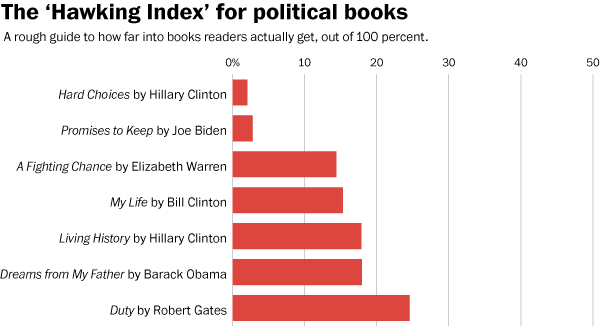
The Hawking Index of Unread Blockbusters

Hawking Index of recent Political Bestsellers

Hawking Index of recent Political Bestsellers

Until now we only had anecdotal evidence that many “blockbuster” books pushed by media and reviewers went largely unread (the most famous past example was Gravity’s Rainbow, critically acclaimed literature that was so dense and bereft of compelling narrative that few purchasers actually finished it.)

But now we have the “Hawking Index,” named after Stephen Hawking for his Brief History of Time, also hugely recommended and rarely finished. While we have no way of knowing how many Major Books purchased in hardcover at bookstores end up as doorstops, we now have data from Amazon Kindle books, which make available on their Amazon pages the location and number of notations users make within the book; it turns out many books have notations near the beginning but few or none near the end, indicating users did not make it that far. Since many books do have notations to the end, we know it’s not just because readers get tired of annotating; they simply stop reading.

WaPo has a good story on this, adding Hillary Clinton’s latest as another much-purchased, rarely-finished book, to go along with Thomas Piketty’s Capital in the Twenty-First Century as a best-selling bust with readers:

The summer’s most-read book? Donna Tartt’s “The Goldfinch.” Least-read? Thomas Piketty’s “Capital in the Twenty-First Century,” for which the notations only get about 2.4 percent of the way in.

So, naturally, we decided to apply this methodology to “Hard Choices” and other recent or comparable political books. And we have our own ranking, which we now present in order from estimated-least- to estimated-most-read.

1. “Hard Choices,” by Hillary Clinton. Hawking Index: 2.04 percent. Well, there you have it. The deepest into Hard Choices the popular highlights get is page 33, a quote about smart power. Three of the five most-popular highlights occur within the first 10 pages. We will note the same caveat that Ellenberg applies to Piketty. “Hard Choices” is fairly new, and fairly long. Still, though, one would think more people had made it past page 33.

The most popular quote? “Do all the good you can, at all the times you can, to all the people you can, as long as ever you can.” Which, like several of the top quotes from the authors listed below, isn’t actually a quote from Hillary Clinton. Instead, it’s a mantra from her family’s Methodist faith.

I took a look at my own book and the highlights readers chose seem to indicate most readers read it all the way through — the two most popular:

Most of the trouble in relationships is about bad signaling and poor responses. (6 Highlighters)

A good partner is reliable and available to help on call, whenever possible; a good partner leaves his partner alone when help is not needed, staying quietly available behind the scenes…. (5 Highlighters)

…which I actually wrote, though some of the prettiest language highlighted by users is quoted from other books (where a thought was expressed so beautifully I could not improve upon it.)


Game of Thrones and the Problem of Power

game-of-thrones-season-4

[HT to friend Frank Yellin for pointing this out.]

Rolling Stone has a long interview with George R. R. Martin, writer of the Game of Thrones series. I saw him signing books at the World Science Fiction Convention some years back, and he was already a star before HBO turned his series into a mass market hit.

One of the reasons why the series (a riff on the kind of clashes seen between family dynasties in the Middle Ages, set in a kind of fantasy Europe) is popular is its realistic portrayal of both responsible and irresponsible lusts for power, unintended consequences, and the difficulties of governing even for those of noble intentions. Everyone acts out of what they think are their interests, and in keeping with their character, and yet the results are often completely unexpected and tragic.

As Martin comments:

Q: A major concern in A Song of Ice and Fire and Game of Thrones is power. Almost everybody – except maybe Daenerys, across the waters with her dragons – wields power badly.

A: Ruling is hard. This was maybe my answer to Tolkien, whom, as much as I admire him, I do quibble with. Lord of the Rings had a very medieval philosophy: that if the king was a good man, the land would prosper. We look at real history and it’s not that simple. Tolkien can say that Aragorn became king and reigned for a hundred years, and he was wise and good. But Tolkien doesn’t ask the question: What was Aragorn’s tax policy? Did he maintain a standing army? What did he do in times of flood and famine? And what about all these orcs? By the end of the war, Sauron is gone but all of the orcs aren’t gone – they’re in the mountains. Did Aragorn pursue a policy of systematic genocide and kill them? Even the little baby orcs, in their little orc cradles?

In real life, real-life kings had real-life problems to deal with. Just being a good guy was not the answer. You had to make hard, hard decisions. Sometimes what seemed to be a good decision turned around and bit you in the ass; it was the law of unintended consequences. I’ve tried to get at some of these in my books. My people who are trying to rule don’t have an easy time of it. Just having good intentions doesn’t make you a wise king.

For more on pop culture:

The Lessons of Walter White
“Blue Valentine”
“Mad Men”
The Morality of Glamour
“Mockingjay” Propaganda Posters
“Big Bang Theory” — Aspergers and Emotional/Social Intelligence
Real-Life “Hunger Games”: Soft Oppression Destroys the Poor
Reading “50 Shades of Grey” Gives You Anorexia and an Abusive Partner!
YA Dystopias vs Heinlein et al: Social Justice Warriors Strike Again
“Raising Arizona” — Dream of a Family

For more on politics and unintended consequences:

Life Is Unfair! The Militant Red Pill Movement
Madmen, Red Pill, and Social Justice Wars
Unrealistic Expectations: Liberal Arts Woman and Amazon Men
Stable is Boring? “Psychology Today” Article on Bad Boyfriends
Mate-Seeking: The Science of Finding Your Best Partner
The “Fairy Tale” Myth: Both False and Destructive
Why We Are Attracted to Bad Partners (Who Resemble a Parent)
Culture Wars: Peace Through Limited Government
Social Justice Warriors, Jihadists, and Neo-Nazis: Constructed Identities Disregarding Facts