Science Fiction

New Review: “Nemo’s World: The Substrate Wars 2”

Nemo's World: The Substrate Wars 2

Nemo’s World: The Substrate Wars 2

This review of Nemo’s World just turned up on Amazon, and since I’m a Facebook friend of the reviewer (who tries to read and review lots of work — that’s the extent of our relationship!), I’m copying here in case the Amazon algorithms strike again and erase it:

5.0 out of 5 stars
A wonderful book about SCIENCE MAGIC and how real people react. BUY IT NOW!
December 14, 2015
By Pat Patterson

This IS, by golly, a review of the second novel in the series, and it’s name is Nemo’s World. I say that, because somehow I convinced myself that it was Red Queen. No, you dope, Red Queen is the FIRST novel in the series, and you reviewed that in September. /end apology for being a dork/

This is a SCIENCE book about PEOPLE. It is not a ‘meanwhile, back at the asteroid’ book, which merely transmits Perils of Pauline into outer space. It is also not a ‘gee-whiz, look at the quasar explode!’ book, which only uses the people to discuss something esoteric. It is, instead, a well-written book about what real people do when they encounter technologies which have the capacity to free or to imprison or to destroy. The technology itself is ethically neutral; it is the character of the people that determines whether or not the outcome results in the maximal value of goodness in the universe or not. You know that bit about sufficiently advanced science being indistinguishable from magic? That could easily happen in this book if the author just used hand-wavium. However, a good bit of the first third or so of the book is given over to explaining just how all this works. So, take heart: you do NOT have to have advanced studies in physics to understand what’s going on in the book. And, if you really don’t care, just skip over the explanations like you did during the whaling parts in Moby Dick.

The characters are carried over mostly from Red Queen, with some new additions. In my humble opinion, however, they aren’t the SAME characters, because they change in light of new developments.

The principal technological applications are a result of discovering how to use the underlying structure of the universe (the substrate) as a source of computation and power. The two most significant applications are first the ability to create windows into other distant locations, and second the ability to create exact replications of physical objects. Thus, we have infinite or near infinite growing room, and infinite resources. In the world of intense government control described in the first book, this is an immediately destabilizing factor.

Okay, I want to shift to what I believe is the most interesting ethical question posed by the technology, which is the replications of human beings. Steve is the genius behind the discovery and development of the new technology. Whether or not it is required that his type of genius also be socially inept is not clear, but Steve is certainly found to be pretty far along on the Aspergers/autism scale. It’s actually quite a beneficial characteristic for him to have, at least in the early stages, since he hasn’t been talking to other people about what he has discovered, and also because he pretty much ignores everything around him in order to enjoy his work. And, to be greatly specific and intentionally offensive, he don’t seem to care for chicks. HA HA! As it happens, there is a certain young lady from the sub-continent of India who DOES care for him! And whether or not he notices, she acquires him by the provision of moving into his tent. I feel relatively certain that Steve had SOME input into the arrangement, but it is clear that Rasna is the active agent here, and it is a Good Thing. And, when you add a Good Thing to a Bad Thing, then you get a Some Thing!

Here’s the Bad Thing: There is so much essential development which must be handled immediately, and it can only be handled by Steve due to his brilliance and grasp of theory, that he simply can’t handle it all. It simply CAN’T all be done, yet it MUST be done, and it means that Steve doesn’t even have a chance to eat or sleep, much less explore his relationship with Rasna. So, he uses the replicator, and creates another Steve.

In public, they use the fiction that this is Steve’s twin brother Larry, just in from Viet Nam, who speaks very little English. It works, for the public.

But MY immediate question is this: since the Larry is the same as the Steve, does he not have equal standing? And specifically, what is relationship with Rasna? Sure, share the work; that presents only minor problems. But share the companion? Rasna reveals that she can’t tell them apart, but states that she doesn’t care, as long as it’s the original she’s sleeping with.

How does she know?

And what about the Larry/Steve’s position on the matter? He has been completely replicated, which means he emerged from the replicator with the same emotional set-up and memories of Rasna as Steve/Steve; isn’t denying him the pleasure of her association the ethical equivalence of denying Steve/Steve?

As I was reading this, I thought, Maybe this is a third application where Steve’s Asperger’s is going to be a benefit. Perhaps he really hasn’t bonded with Rasna at all, so emerging into being without the physical requirement to spend time and energy with her is going to be seen as a plus, and not a minus. Maybe you can replicate geniuses with Asperger’s at will, and never suffer any social complications.

But then it occurred to me: why not replicate Rasna, and call her something else, like Shakuntala, the warrior empress from the Drake/Flint Belisarius series, and pair her up with Larry/Steve?

Aha!

BUT: Rasna does NOT have Asperger’s! And neither would Shakuntala/Rasna, and so what would be the likelihood that she would ALSO demand to be the only one to sleep with Steve/Steve?
He he.

Okay, Jeb Kinnison, how are you going to write your way out of THIS mess?

The small group who program the new technology recognize how much trouble it would cause to have human copies, so they write the programs for normal use to recognize and prevent copying of living things. Steve’s use is a one-off, with the alternative — opening up direct substrate programming to more programmers — viewed as too dangerous to allow. The plot in the next book requires restoration of a lot of backup copies of people, and so the issue will have to be faced. As with all powerful technologies, there are compelling reasons to use it, and real dangers as a result…

Rasna accepts Steve for who he is, and revels in taking care of him despite his limitations and absorption in his work — this has been a pattern for lots of great scientists, and many partnerships are founded on complementary personalities like theirs. You’re quite right that copies of Rasna would find it more difficult to accept the situation, and over the longer term, the copies of Steve may well deserve equal status and a Rasna-copy of their own, likely by moving to another planet to avoid confusion!

If you haven’t read the first in the series, Red Queen: The Substrate Wars 1, it’s best to start there.
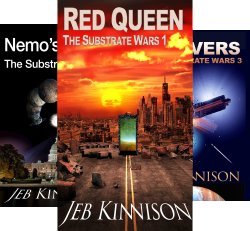
Open Letter to Jeff Bezos re Review Erasures

Another data point for the self-pubbed dealing with Amazon’s paranoid reviews policy. I uploaded the latest Nov. 25th, and by Dec. 1st had eight 5-star reviews from the 20 or so people I had emailed ARCs to. Amazon deleted the last three reviews, all posted on the same day, claiming they had found “associations” between the accounts. I suspect it is a dumb algorithm that assumes too many 5-star reviews too quickly must mean they are paid, and that Amazon is lying about it.

Here’s their boilerplate language:

We removed the Customer Reviews for your book because our data shows elements of your Amazon account match elements of the reviewers’ Amazon accounts. In these cases, we remove the reviews to maintain trust in our customer reviews and avoid any perception of bias.

Customer Reviews are meant to give customers unbiased product feedback from fellow shoppers. Because our goal is to provide Customer Reviews that help customers make informed purchase decisions, any reviews that could be viewed as advertising, promotional, or biased will not be posted.

Here’s my response:

I have read your guidelines thoroughly and note “family and *close* friends” is the standard you cite to disallow reviews. I share your desire that reviews be unbiased and fair across products. I question your commitment to achieving this goal when you will not remove obviously fake one-star reviews which have been posted by competitors or people who dislike the book’s author for political reasons.

First let me comment that I bring Amazon significant yearly revenue on my books, audiobooks, etc. My family also directly spends about $10K per year with you. You have set up an algorithm which uses poor guilt-by-association correlation data to intentionally wipe out the hard work of Amazon customers who take the time to review my works, which damages my perception of Amazon, and as we the authors make our stories known, will damage your other customers’ views of your company.

Self-pubbed authors must make more efforts to keep in touch with their fans to have any chance of succeeding in a marketplace dominated by legacy publishers who are allowed to promote their products by direct payments to Amazon. Your efforts to give small press and self-pubbed authors a way to advertise are complete failures. Amazon has allowed legacy publishers to overprice their ebooks, pay you for what appear to be endorsements, and game the reviews system with large numbers of paid reviews for their products.

Frankly I think you are lying. You have implemented a review-cancelling algorithm which in my case appears to have been triggered by “too many” 5-star reviews in a short time, since you cancelled the last three out of eight, and those three are fans of my writing, not family or *close* friends as you specify in your guidelines. I think it is just accidental that all eight of my first reviews were 5-star, though it’s possible it’s just that good a book.

You have damaged our relationship. I request a re-review and restoration of those three erased reviews.

The erased reviews, (all 5-star), and not a hyped or misleading one in the group:

1) Stephen Marino reviewed Shrivers: The Substrate Wars 3
I very much like the story – December 3, 2015

First let me start with the disclaimers.

1, I helped workshop part of this story at Taos Toolbox.
2. I was a beta reader of the completed work.
3. I very much like the story.

Because I am giving this story all five stars, let me state why you should not read it.
Do you like to think for yourself or do you want every little detail of what is happening spelled out for you? If you only like to read fluff, this is not your book. I am not saying, it is a hard read, just that it is many layered. Pay attention to the sub subtexts.

Do you only like to read books from authors who have no understanding of technology and the effects it can have on society? If so, there are lots of writers who don’t know what they are talking about.

Have you read the previous books in the series? If not, You will probably enjoy the book more, if you start with Red Queen and move on to Nemo’s World. The story stands alone nicely, but a bit of background can be a good thing. (You can’t unread book three before going back to read 1 and 2.)

What are the books about? Spoiler free, this universe is a big honking computer simulation and in about 20 years, a few university students begin learning to program it. The world is beginning to go in a very dystopian direction and war breaks out between the students and the world’s governments.

I know this has been said by everyone who has read this series, If you enjoyed Robert a. Heinlein, You will greatly enjoy this author.

2) Bookgirl reviewed Shrivers: The Substrate Wars 3
Engrossing addition to the Substrate Wars saga – November 30, 2015

Shrivers are coming.

Complex plotting, political intrigue, and a galaxy­spanning saga. Shrivers builds relentlessly to a climax filled with surprises. Kinnison weaves multiple plot lines, characters, and different planetary settings together adroitly, crafting a tale that will captivate and delight hard science fiction fans.

3) M. Cunningham reviewed Shrivers: The Substrate Wars 3
Captivating read – November 30, 2015

I was provided an advanced reader’s copy for review and found it to be a captivating and entertaining read. Mr. Kinnison has channeled his inner Heinlein to create a fitting wrap­up to the Substrate Wars trilogy. I was especially impressed by the creative use of Kat’s training in the virtual reality world of the substrate to create stories of how other aliens lived and reached the substrate. I would highly recommend this book to anyone who appreciates the golden age of science fiction.

1) Properly discloses the relationship with the author. But it is a competitive relationship, and he is not my friend, much less my close friend.

2) No idea who “book girl” is, probably one of the 8-10 book bloggers I sent an ARC to for review. Arm’s-length.

3) Fan who has reviewed previous books and so was willing to read the ARC. Gave the previous books 4-stars, so not a pushover.

So stop lying about supposed “elements matching” — no such elements exist, though in the case of #3 I sent him a paper copy so that might appear in your search. The others have NO CONNECTION WHATEVER in account records.

Stop lying. Restore the reviews. Or authors and readers will turn on you. Why should customers make an effort to review books when you may arbitrarily erase their work?

A comment on Facebook:

I’m guessing they don’t want to admit that one of their computer guys has run a correlation study and suggested a simple “too-many-five-stars-too-quickly” screen. That might cut fake reviews down, but also cuts legitimate ones. And it’s embarrassing to admit they can’t come up with something more sophisticated. People are worried about them tracing Facebook and email list connections, but I’m pretty sure they have no access to that data… and apparently authors signed up with Amazon press labels are immune (hi, Robert Bidinotto!)

copied from createspace groups:

10. Aug 5, 2015 11:32 PM in response to: lipmag
Re: Amazon reviews – petition

The issue I have with Amazon’s review policy is that it does not accurately apply across the board. Yes I understand the need to ensure authors are not padding reviews otherwise the reviews will hold no value to the potential customers however, with my latest release Amazon Amazon randomly decided to remove 2 reviews generated through ARC releases. The only response given when queried as to why was that the reviews violated policy because they believed the reviewers knew the author. They knew of the author, obviously, but these were not friends and family. Additionally, upon review of the posted Reviewer Policies the only sections that could apply (though they do not) are

• Sentiments by or on behalf of a person or company with a financial interest in the product or a directly competing product (including reviews by publishers, manufacturers, or third-party merchants selling the product)
• Reviews written for any form of compensation other than a free copy of the product. This includes reviews that are a part of a paid publicity package

The reviewers were not compensated nor do they have a financial interest. This brings me to my original point. They do not apply the guidelines across the board. I have never heard complaint from a large publisher that an ARC review was subsequently removed. In fact, many large publisher purchase reviews as part of their marketing plan (a direct violation of the above guidelines) and those reviews are rarely, if ever, pulled.

The entire process seems to a) not follow the published restrictions and b) be enforced in a discriminatory fashion. In my experience questioning Amazons decision or pointing out that the guidelines were not broken has no effect. In the end the do as they please.

— R. C. Butler – Bulldog Press

Other stories on the topic:

Amazon Review Policy Under Fire: Indie Authors Call For Change In ‘Big Brother’ Policing

Amazon’s Review Policy is Creepy and Bad for Authors

Amazon… A virtual marketplace, or Big Brother?

Petition on Change.org – Change the “You Know This Author” Policy

IndieReader Best of 2015: “Nemo’s World: The Substrate Wars 2”

Nemo's World: The Substrate Wars 2

Nemo’s World: The Substrate Wars 2

Of the indie books they reviewed (thousands?), IndieReader selected Nemo’s World as one of the 56 best of the year 2015:

A group of idealistic scientists use gateway technology to save the United States in NEMO’S WORLD By Jeb Kinnison
The second installment in Jeb Kinnison’s The Substrate Wars series takes place in the near future where the US has become a one-party oligarchy opposed by a group of rebel scientists and humanity is poised to destroy itself in the name of “security.”

Here’s their review:

5 STARS
IR Verdict: Good science fiction is usually about humanity rather than deep space or death rays. NEMO’S WORLD is well-written science fiction that harkens back to the golden age of Heinlein and Asimov.

If you haven’t read the first in the series, it’s free until Friday: Red Queen: The Substrate Wars 1.

“Shrivers” First Reviews

Shrivers: The Substrate Wars 3

Shrivers: The Substrate Wars 3

So far the reviews are mostly from people who read the less-polished advance reader copy I sent out. Here they are as of today — all five-star, which is a little offputting. The sample is skewed because these are readers who really liked the first two, so I expect new readers will be less kind!

Engrossing addition to the Substrate Wars saga
By Bookgirl on November 30, 2015

Shrivers are coming.

Complex plotting, political intrigue, and a galaxy-spanning saga–Shrivers builds relentlessly to a climax filled with surprises. Kinnison weaves multiple plot lines, characters, and different planetary settings together adroitly, crafting a tale that will captivate and delight hard science fiction fans.

Captivating read
By M. Cunningham on November 30, 2015

I was provided an advanced reader’s copy for review and found it to be a captivating and entertaining read. Mr. Kinnison has channeled his inner Heinlein to create a fitting wrap-up to the Substrate Wars trilogy. I was especially impressed by the creative use of Kat’s training in the virtual reality world of the substrate to create stories of how other aliens lived and reached the substrate. I would highly recommend this book to anyone who appreciates the golden age of science fiction.

Be careful what you wish for
By Rich on November 29, 2015

The third book catches up with what we’ve been wondering from the start– where is everybody else? The riddle of the Fermi Paradox is resolved, but the answer makes them wish they’d never asked the question. The limits of the seemingly unlimited new technology are revealed, with multiple major plots lines racing to meet where not only is humanity’s future at stake, but the soul of the universe. Kinnison handles the tasks with a tight focus and new characters, a thoroughly enjoyable conclusion to the series. (Note this review is for an advanced reader’s copy provided by the author.)

Just Survive Somehow
By Stan on November 28, 2015

(The review title is an Easter egg for TWD fans.)

The Substrate Wars continue with the third book in the series, and now the stakes are raised even higher: the potential destruction of all earth-based life! While looking for other civilizations, our heroes find nothing but devastation, utter and complete destruction. Planets nuked so thoroughly that the survival of anything but low-level deepsea-dwelling organisms is rendered impossible. Formerly advanced civilizations: gone, utterly wasted, from millions of years earlier to only a few hundred. This is a mystery to them until they unwittingly make themselves known to the Shrivers, a force reminiscent of Saberhagen’s Berserkers. Even though earthmen are now distributed in colonies dispersed about the galaxy, nevertheless they are all at risk, not only from the Shrivers, but from an unexpected early personal enemy. To find out if and how they survive this latest menace, read Shrivers! The action which some felt lagged a bit in the second book is back with a vengeance in the third book and now we have to await a fourth (and more?) book to find out what happens next.

An Excellent Ending to an Great Series!
By Joseph F. on November 27, 2015

When Jeb offered me the chance to take a look at the third book in his trilogy before it was released, I was thrilled to take him up on it.

I loved the first book, had a few minor quibbles with the second one but was absolutely astounded by the third book. I know, I reread it two times trying to knock holes in it knowing that if I found anything, Jeb would immediately address the issues, making it that much better.

Even after going back and rereading the whole series, I was not able to find anything at all that did not ring right. I looked hard and didn’t find a darn thing that I could jump on.

By far, this is the best book of the series–not that the other books aren’t excellent and I am one of those many readers who can really hardly wait to see what Jeb has in store for us in the future.

Hard science, and good action
By Donald W. on November 27, 2015

This review is based on a pre-release beta, some things may change in the final edition, I’ll let you know after Tuesday Dec 1, when the book is delivered 🙂 As Volume 3, most of you interested have read the first two, but if you are new to Jeb’s writing, I think you can jump in with this one cold. With the 10 year ‘hiatus’, since the first two, the plot will flow, but you will miss all the incredible speculative hard science of the first 2 books.

With that said, there is a lot of incredible speculative hard science in this one, not predicated on the originals, but supplement and extending it. Oh, and the plot just sings along, an interwoven tapestry of people, places and events that come together for the exciting conclusion (until Vol 4, which you should, along with me demand Jeb write soonest).
Without spoilers, the Shrivers kill civilizations, but the ancient civilizations do indeed exist. A fascinating speculation into the Fermi Paradox, it is entertaining as well an interesting take to an old problem we have been kicking around for a hundred years.

The galactic saga continues….annihilation or redemption
By Michael Z on November 27, 2015

I have read the previous two books in this series and really enjoyed reading them. This is the third, and it is a real page turner as well. These are my favorite type of scifi stories, non-stop action, twisting plot, space travel, technology and grand social implications. Every time one crisis is resolved another bigger one takes its place.

Jeb has grown the story to be galactic in scope. Finally, aliens have started to get involved. And they are taking sides. The stakes have gotten really big, total annihilation or redemption.

FREE until Friday: “Red Queen.” Holiday sale on Substrate Wars

Shrivers Kindle Cover

Shrivers Kindle Cover

The Kindle versions of Substrate Wars books are on sale until Friday — FREE for Red Queen, $0.99 for Nemo’s World, and $2.99 for the just-released Shrivers. Similar bargains are available in some non-US Amazon sites.

Too bad I can’t offer a similar discount on the trade paperbacks, but the bundle of three makes a good gift for your STEM graduate friends or relatives who like thrillers with heroic scientists — c. 1000 pages of fun reading.

30% off today: “Shrivers” Trade Paperback

Shrivers: The Substrate Wars 3

Shrivers: The Substrate Wars 3

I’m avoiding holiday shopping craziness by mostly buying from Amazon. Note the Black Friday special there — 30% off any printed book: “To use this promotion, you must enter HOLIDAY30 at checkout under the ‘Gift cards & promotional codes’ section to receive 30% off any ONE (1) book, with a maximum discount of $10.”

Gift idea: my latest, Shrivers: The Substrate Wars 3, just came out.

First review: “…a real page turner… These are my favorite type of scifi stories, non stop action, twisting plot, space travel, technology and grand social implications. Every time one crisis is resolved another bigger one takes its place.”

The discount only applies to the trade paperback link. The Kindle version is here.

Tangent Online on: “Nemo’s World: The Substrate Wars 2”

Nemo's World: The Substrate Wars 2

Nemo’s World: The Substrate Wars 2

New review in Tangent Online.

Running through all of the machinations and maneuverings, personal stories of love and loss, sacrifice and heroism—and of course treachery—is the ages-old story of a band of rebels fighting for freedom against almost insurmountable odds. Kinnison handles all of this with aplomb and a sure hand, making for an engaging, page-turning read.

Nemo’s World is the second book in the Substrate Wars series, which starts with Red Queen: The Substrate Wars 1.

Heinlein Bust Time-Lapse Video


The Heinlein bust to be displayed in the Missouri state capitol’s “Hall of Famous Missourians” is in progress, with a planned unveiling in 2016 and possibly an appearance at the Worldcon in Kansas City that August. The piece is being done by E. S. Schubert, whose site is worth a look. The results are a good likeness of late-stage Heinlein, and I’m happy to see it coming together.

I wrote about my donation here. My donation was only about 20% of the funds required, but I was happy to put it over the top so work could begin early enough to get it to KC in time.

[Jeb Kinnison writes at JebKinnison.com and SubstrateWars.com, and his second science fiction novel, Nemo’s World, is “well-written science fiction that harkens back to the golden age of Heinlein and Asimov.” — IndieReader.]

Death of “Wired”: Selected Comments

RIP Wired

RIP Wired

The Wired article I posted about here created quite a stir. It is from the latest issue, which I’ve looked through — it looks like a desperate ploy for attention, and the readers reacted in the Wired.com comments on the editorial lead-in story, “The Battle for Equality is WIRED,” with these perfect skewerings:

You know what the saddest part of this is? The equality movement had won. It won ages ago, decades. Oh, those beating the drum may not think so, but they had. I turn 40 in a week. When I was a kid, it was drilled into me to treat people with compassion whether they were white, black, straight, homosexual, whatever. I was happy to do it. The only missing element to the change that the equality movement wants was one that change requires – time. Over time, with little nudging, minds would change, attitudes would change.

But no, it’s wanted right now. People are to simply wake up and instantly think in a completely different way. To accomplish this, the movement has used the tools reserved for the worst of budding oppressive regimes – shaming, fear, threats to livelihood, all behind a facade of inclusiveness and friendliness, a mockery of compassion, and a play of weakness even as the movement has held all the power. The question of government is no longer how to promote freedom for us all by finding common ground, but whose side it will take. Because the movement has snapped the common thread among us, it is required that a “side” must be chosen within this country (Talking the U.S. here). And while it may seem the movement is ahead, trust me, there is NO winner in such a scenario.

Note that I said in the beginning that the equality movement “had” won. This barrage of constant propaganda, this barbaric level of social engineering to force people to crawl into their own heads and hide, while having to outwardly smile and pretend to behave as told is beginning to fail. Just looking at comments on articles such as this is evidence of it. They’re sick of it – I’m sick of it. Equality and diversity are lofty, wonderful goals – but as with anything else, they twist into a tragic evil when they become an obsession. And in the United States, at least, this has become an obsession.

I know by now anyone who disagrees with me is probably foaming at the mouth thinking me the root of all evil. But this isn’t a “I can’t wait to see you fail” message. Actually just noting that the path this movement is no longer attracting people, it’s pushing them away. The answer? Stop pushing. To be truly inclusive is to invite everyone with the understanding not everyone will take that invitation.

To sum up for Wired – Perhaps maybe you should take the suggestions I see from many on here and return to a focus on, I don’t know, technology? How about a positive-toned magazine showing what the best and brightest in the world are creating, and how it can help? I miss that optimism Wired once had. Frankly, if I want drab “oh what a horrible unfair world we live in” media, I have essentially almost every other publication or news broadcast around to look at.

And that’s the end of my rambling.

Problem is, morally driven people simply can’t accept their quest is over, that they won or even leave it alone. That’s because, deep within, we are addicted to righteousness. That feel good sensation of being just and fair, on the side of good. Religion thrives on that addiction. People will devote their entire lives to get it and keep it flowing.

But currently religion no longer is the main purveyor of moral righteousness, at least in the West. It’s all these secular moral quests (feminism, pacifism, the green movement, etc), started mostly during the XXth century and with good reasons behind them. Created to supposedly change and fight the older moral codes and former causes for feeling righteous and good, but mostly, as a replacement for religious fervor and righteousness.

It’s also a matter of education: since the counter-culture movement started, most educated people has been raised with the liberal mindset almost burned into them as an unthinking code of behavior, and the unflinching belief that they are special and worthy, whatever they are, with their goal in life being happy.

But guess what? life really doesn’t warrant those expectations of self-importance and value all the time. Even people raised in the most liberal and sensitive background can be mistreated, undervalued and unhappy with their overall life.

What’s wrong with the world then? if the liberal mindset won and I’m aligned with it, why am I so unhappy, aimless and lacking purpose?

It must be a conspiracy of course! the Man and the old boogeymen have made a return and one with a vengeance! because other people can’t see the ugliness me and my Internet-enabled peers have seen. And thanks to the Internet, I now have an echo chamber of people keeping my confirmation bias strong and going.

James May posted these two comments on my piece which deserve to be read more widely:

Science fiction author Robert Heinlein had an imaginary Future History timeline which included an era called “The Crazy Years.” It’s amazing the SF community was the first to completely fall to our current gender feminist madness, the irony being SF was the most prepared to avoid it by being a canary-in-a-coal-mine genre of warning literature of precisely this type of dystopian world. Even more irony is we were sandbagged by Orwell’s perceptual trap where authoritarian fascism wormed its way in by talking about wheel chair access, social justice and allergies to scented products. The modern KKK is probably kicking themselves for not coming up with that first.

Typical of our new lack of self-awareness is our Orwellian habit of looking at bald-faced racism and bigotry straight in the face and calling it “anti-racism” and “anti-bigotry.” A small slice of how stupid our community has become is typified by TorCom’s Liz Bourke and her column “Sleeps With Monsters,” the title of which is a quote from a poem by the insane lesbian feminist Adrienne Rich. In that 1963 poem Rich shows marriage in the same dystopian light Orwell did his future England, a place of scuffed edges, dead dreams and hollow stupidity. Why are we not surprised a bigoted lesbian ideologue like Bourke was among the first to fist-pump Ann Leckie’s SF novel Ancillary Justice, a mediocre work but which had the good sense to signal boost lesbian feminist dogma about “genderblindess,” the cure for Rich’s “compulsory heterosexuality.”

In keeping with the idea of seeing marriage as a cultural cul-de-sac, we have retroactively not only declared all SFF prior to 2009 or thereabouts as a woman-hating, racist, homophobic delight through our new “feminist” lens, but any straight white male who had the temerity to be born without apologizing to our new overlords for the East India Company, the Atlantic Slave Trade, and pretty much any evil humankind has ever indulged in, as long as all other ethnic groups who did the same are thrown into Orwell’s memory hole. We have also decided to wage war on success itself and build statues to failure who talk to us about imaginary restaurants full of menacing face-punching “white cis dudes.”

The Wired article is fit only for Orwell’s Ministry of Information and as an illustration of how far we’ve fallen, been duped, become stupid and utterly unworthy of a legacy where E. M. Forester and Ray Bradbury shouted at us to no avail. Adrienne Rich is our literary hero now, and God help us.

Let’s call the Wired article what it is: lying. It lies from the beginning to the end. I’d need to write a short book to unpack all the falsehoods. One bald-faced lie even touches on GamerGate, and the irony there is one of the sore points with GamerGate were unethical articles like this one which put forth premises with no sourcing or quotes whatsoever and treats them as gospel. And that gospel is the same as in GamerGate: a moral ethos based on straight white men always being wrong and always up to something. For a sick ideology which laughs at the idea of “cabals,” the justice league of race and gender stipulates any time there are too many men, whites or heterosexuals in a hobby there’s some sort of collusion at work, though these sorry “feminists” never provide any proof of such a thing other than demonization theories about “white male cis privilege.”

In a few short years these nuthatches have ruined our hobby. I’ll tell you this, anyone who holds N. K. Jemisin up as a voice of social justice is too far gone to reach.

“Tomorrowland”: Tragic Misfire

Tomorrowland

Tomorrowland

[Edited to add material after watching it again to catch more dialogue]

Having read mixed reviews, I waited until Tomorrowland came out on cheaper streaming services. Directed and mostly written by Brad Bird, auteur of brilliant work like Iron Giant and The Incredibles, the previews looked promising — a story about the shiny visions of the technological future we had as kids in the 1960s, and a world where they actually happened.

The first two-thirds of the movie are great — the young heroine gets into trouble for trying to save a NASA launchpad from demolition. The failure of dreams and a rising tide of pessimism have left the world obsessed by dark visions of dystopic futures. Then she finds a pin which, when touched, transports her to Tomorrowland, which riffs on Walt Disney’s vision enshrined in the eponymous part of Disneyland. There are several Disney in-jokes, like one robot’s insistence that she’s “audio-animatronic,” Disney’s term for lifelike automatons.

Tomorrowland is congruent with Earth but in another dimension, and was founded by Tesla, Edison, Jules Verne, Gustave Eiffel, and similar geniuses as a place for the best and brightest scientists and artists to work on dreams of the future unlimited by politics and hidebound Earth thinking.

The heroine meets Frank (George Clooney) as an older scientific genius who was brought to Tomorrowland as a child, but then was exiled for inventing a machine to predict the future, which foretold of disaster to come. They are chased by killer robots to Tomorrowland itself, which is decaying and abandoned. The apparent dictator of Tomorrowland, played well by Hugh Laurie, is the only Tomorrowland resident we meet who isn’t a robot, and he no longer believes humanity deserves to be saved. The explanation for the decline of Tomorrowland is never given, but a thriving high-tech colony in 1964 becomes a dystopia in 2015 with a dictator who ruthlessly kills anyone who gets in his way. The movie shows its deep schizophrenia here — having satirized today’s obsession with dystopias and pessimism, it doesn’t even bother to explain why a settlement founded on idealism should turn so sour. The one hint comes when dictator Nix tells Frank it was his fault for not believing. And later it’s suggested that the heroine’s refusal to give up can magically effect the probability of doomsday. So the woo factor a la “The Secret” appears, with the trite metaphor of the two wolves: “You have two wolves, one representing darkness and despair, the other light and hope. Which one lives? The one you feed.” So it’s all about attitude!

After much clanking plot with explosions, fights, chases, and other worn-out devices, the bad machine that is creating negative consciousness on Earth is destroyed, and the future looks more hopeful. Nix admits he was intentionally beaming negative thoughts at Earth, expecting they would motivate people to fix the problems leading to Doomsday, but they just reveled in despair and refused to sacrifice convenience. Ahem?

The vision is inspiring. But the end is chilling — bad machine destroyed and dictator killed, a new corps of fresh-faced young robots will recruit the artists and scientists of the future to persuade others to apply creativity to fix problems. This bit looks like an Apple commercial, with its gauzily sentimental multicultural recruitees.

The laundry list of problems shown as destroying the Earth includes global warming (the melting glaciers and flooding coastal regions are shown), nuclear war, and political unrest. Putting the clues together, the solution is found by persuading people to sacrifice comfort to do what is necessary as instructed by the best and brightest. So a kind of techno-fascism will save the planet! This has little of the optimism we associate with Disney, and a lot of today’s politicized environmentalism.

The script loses faith in the audience and resorts to the same old villains, fights, and chases to keep their interest, when the material is fascinating enough without demonizing anyone. As a result, instead of exploring the issues in depth, most screen time is action. It might as well be a Transformers movie for most of its running time.

There’s a parallel with the book I’m working on now, Shrivers: The Substrate Wars 3. Near the end, a “Galactic Tribunal” similar to the one in Heinlein’s Have Space Suit–Will Travel is deciding whether to destroy humanity, or allow it to join the community of intelligences living in the computational substrate of the universe. The young woman pleading our case ends her testimony with this:

“I just have one more thing to say.” Kat didn’t know where this was coming from, but she had to speak. Aurora looked alarmed.

“You sit in judgment of us. If you applied the same standards to the oldest among you, how many would pass? How many are still making an important contribution to knowledge? I’ve experienced each of your lives — you were driven, reaching for the stars, and working to advance your people. But how many of the First are lost in some virtual dreamland, using cell space for nothing but fantasies? And you judge other civilizations and have them murdered in their infancy so that you might never be inconvenienced or have to give one moment’s thought to the outer universe. You don’t want to think of the cost — you kill the new life you don’t want to know about and can’t be bothered to assist, while more and more of you do nothing.”

Quog’s eyebrows had gone up. “Do go on.”

“If I am ever uploaded,” Kat said, “I’m going to work. I’m going to find a way to bring every civilization forward. It can’t be that there’s just not enough space for everyone. There must be a way to expand it.”