Mirror Neurons and Irene Gallo

Sad Puppies 4 Logo

Sad Puppies 4 Logo

Scott Alexander took note of the Irene Gallo episode in his excellent post on the morality of intertribal warfare between SJWs and anti-SJWs, “Fearful Symmetry.”

The “mirror neuron” was a theorized but now mostly discredited idea that humans and perhaps a few other animals had specific neurons that fired when recognizing and emulating another being’s thoughts. The sympathy or empathy they were supposed to generate has always been one of liberalism’s strongest weapons.

A Christian doesn’t decide to tolerate Muslims because she has investigated Islamic doctrines, she decides to tolerate Muslims because she can put herself in a Muslim’s shoes and realize that banning Islam would upset Muslims in the same way that banning Christianity would make her deeply upset.

If the fear and hypervigilance that majority groups feel in social-justice-dominated spaces is the same as the fear and hypervigilance that minority groups feel in potentially discriminatory spaces, that gives us a whole lot more mirror neurons to work with and allows us to get a gut-level understanding of the other side of the dynamic.

Scott Alexander quotes from a comment on an earlier post:

About the same time that sort of thing was happening in that online community, the same thing was happening in the real-world meat-space gatherings, also quite literally with shrill screams, mostly by [redacted] [redacted]s, who would overhear someone else’s private conversations, and then start streaming “I BEG YOUR PARDON!” and “HOW CAN YOU SAY THAT!”, and by [redacted] [redacted]’s who were bullying their way onto programming committees, and then making sure that various speakers, panelists, artists, authors, dealers, and GoHs known to be guilty of wrongthink were never invited in the first place. Were it not for the lucky circumstance of the rise of the web, the market takeoff of ebooks, especially a large ebook vendor (named after a river)’s ebook direct program, and the brave anchoring of a well known genre publisher that was specifically not homed in NYC, the purging of the genre and the community would have been complete.

Almost nobody wants to physically murder and maim the enemy, at least at the start. That’s, well, the Final Solution. Plan A is pretty much always for the enemy to admit their wrongness or at least weakness, surrender, and agree to live according to the conqueror’s rules. Maybe the leaders will have to go to prison for a while, but everyone else can just quietly recant and submit, nobody has to be maimed or killed. [The social justice community] almost certainly imagine they can achieve this through organized ostracism, social harassment, and democratic political activism. It’s when they find that this won’t actually make all the racists shut up and go away, that we get to see what their Plan B, and ultimately their final solution, look like.

I think Irene Gallo is very talented and focused on her work, and that she sincerely did not question what she had heard from people around her, that Puppies were “unrepentantly racist, sexist and homophobic.” It was poor judgment to post a Facebook update entitled “Making the Sad Puppies Sadder,” plugging “The Geek Feminist Revolution” by Kameron Hurley; the title of the post alone was a slam at part of the publisher’s audience, and unwise. Her off-the-cuff explanation of what Puppies were was just stating openly what everyone around her thought, and she presumably assumed it was uncontroversial among people reading her. The audience for *that book* would definitely be likely to agree with her… but it was still unwise to be doing PR that denigrates whole classes of customers.

I have some sympathy for Irene; social media mobs fixating on an unwise comment or tweet are never good for anyone, and I suspect she wouldn’t hurt a fly or intentionally be rude to anyone. But the incident *does* reveal the likely consensus in her immediate social environment, a consensus which is dismissive and intolerant of people in the other tribe(s). You can see this dismissive attitude among some commenters on File770, who use snark and ad hominem attacks to repel anyone they suspect has Puppy sympathies.

So now let’s talk Brad Torgerson, who has been roasted there with a lot of guesses and insulting presumptions. I was only paying a little attention when I read about the SP3 efforts and started to notice Brad. I suspect he, like other SP3s, expected their little protest to result in maybe a few noms, and he slapped it together in the limited time he had. Now we have people with the benefit of hindsight asking why it was so slapdash — the answer is because they didn’t expect to be very successful, and they were as shocked as anyone when they swept a few categories. We can now guess this was because of the more militant RPs truly block-voting, but no one knew that would happen, so it’s not reasonable to rake him over the coals for not being a strategic genius or putting together the best-thought-out list of nominees.

I know enough about Brad to assume that he’s generally kind and polite to everyone in person, and doesn’t go after people who don’t attack him. He is not perfect, but far from “unrepentantly racist, sexist and homophobic.”

This “attack the slightest flaw” pack behavior is destructive, and I would hope most commenters at File770 are kinder in person. And spending too much time warding off Vox Day is just feeding him; he thrives on chaos and being the center of attention of outraged Right Thinking People, which gets him more fans, and so on. Do you help or hurt someone like this by constantly speaking of them? Like Ann Coulter, he is making a career of being tactless and violating social taboos. This comment fragment from Scott Alexander’s post gets it right:

Vox does this cutesy coquettish flirting with white supremacy precisely so he can say “Why are you getting mad? I didn’t say neo-nazis were good I just said they might not be so bad, why are you getting all upset when I’m just trying to have a calm conversation?”

It really impresses his fans but all I see is a little kid waving his arms in front of his sister’s face and going “I’m not touching you! You can’t get mad because I’m not touching you!”


SJW leftism is the mechanism by which the scribes and academics in our society co-opt the victimization of distant others to defeat their imagined opponents — people independent of their committees and those who are too busy working in profit-making enterprises to watch their every utterance for perfect political correctness. The debates over “rape on campus” are not about rape, really. They are about using the victimization of rape survivors to ideologically cleanse academia, assisted by the current administration’s Title IX bludgeon. It only works because it isn’t rape survivors against evil rapists, it is administrators of universities and the US Dept. of Education against young men and the few remaining professors who might not toe the party line on sexual politics. And it plays into a manufactured “war on women” theme intended to put another Democrat in the White House.

Sons of Liberty vs. National Front

Sons of Liberty

Sons of Liberty

[First published on Sarah Hoyt’s blog 3-7-2016, with excellent comments]

I’ve tried to concentrate on the next book, but events conspire to suck me into the current mess re Trump. Like a lot of observers, so long as he was a sideshow I could see his almost-daily newsmaking as colorful and perhaps useful in allowing others to speak more freely some of the things that needed to be spoken. By doing so he was expanding the Overton Window and giving a voice to sentiments held by large segments of the population that had been suppressed by the MSM, like nativism and the desire to see immigration laws enforced.

But he’s primarily a demagogue who tells the formerly voiceless what they want to hear and promises to defend them against the dangers the privileged “respectable” politicians want to cover up while they continue business as usual — managing the decline of the over-regulated economy and spending the tax money of citizens to bring in new dependent populations who will presumably vote to keep them in place. Having mined this vein of formerly-voiceless anger at the sale of their country to outsiders, Trump has used it to gain the lead in the Republican race despite having no apparent grasp of most policy issues and some frighteningly authoritarian instincts. He has been called a Jacksonian man on a horse, which has some resonance with Osama bin Laden’s remark: “When people see a strong horse and a weak horse, by nature, they will like the strong horse.” Trump’s rise has opportunistic pols and job-seekers endorsing him as a strong horse who can take charge.

The US was founded by several different groups from diverse parts of Britain, and greatly expanded by immigration from Europe. There was no control over immigration — everyone was welcome to pay their own way here, try to survive and fit in, succeed or fail as their abilities and luck allowed. Many returned to their native lands, but most worked hard and helped to settle the land, build the railroads, and grow the cities. In the mid-1800s, just before the Civil War, large numbers of Catholic immigrants from Ireland and Italy flooded Eastern cities and were seen as a threat. The Know-Nothing Party gained power in some Northern cities on a platform of controlling immigration of Catholics, who were thought to be culturally unsuited to freedom and likely to take commands from their corrupt and foreign Pope. Riots between Catholics and Know-Nothings erupted; 22 died in a riot in Louisville, Kentucky before a contested election.

Lincoln needed the support of the remaining Know-Nothings in the election of 1856, when Republicans began to pick up Know Nothing support to oppose the Democrats who supported slavery. But in a private letter, he said:

I am not a Know-Nothing — that is certain. How could I be? How can any one who abhors the oppression of negroes, be in favor of degrading classes of white people? Our progress in degeneracy appears to me to be pretty rapid. As a nation, we began by declaring that ‘all men are created equal.’ We now practically read it ‘all men are created equal, except negroes.’ When the Know-Nothings get control, it will read ‘all men are created equal, except negroes and foreigners and Catholics.’ When it comes to that I should prefer emigrating to some country where they make no pretense of loving liberty — to Russia, for instance, where despotism can be taken pure, and without the base alloy of hypocrisy.

These nativist movements were defused by the tensions over slavery and the approaching Civil War, and the Know-Nothing Party faded after 1856. Irish took over the police forces of most Northern cities, and Democratic political machines used the Irish and Italian immigrants as a base to take over most big city governments. Over generations, these supposedly bloc-voting groups splintered, and the rough and ready disciplines of capitalist employment encouraged integration.

Immigration began to be restricted after a flood of Chinese workers to the West. Congress passed the Chinese Exclusion Act in 1882 which targeted a single ethnic group by specifically limiting further Chinese immigration. In 1907, a “Gentleman’s Agreement” with the Japanese government limited visas for immigration from Japan. Restrictions on the number of immigrants from Southern and Eastern Europe were imposed in 1924, and in 1932-33 immigration was nearly shut off. Local and state authorities, assisted by Hoover’s and then FDR’s Labor Department, coerced repatriation and deportation of between 500,000 and 2 million Mexican Americans, mostly citizens, in the Mexican Repatriation.

In 1965 the immigration law was rewritten, with tight quotas for Eastern and Western hemispheres. Separately, “family class” immigrants were favored outside of the quota system, so one immigrant could settle then sponsor others, who sponsored others, and so forth, allowing entire culturally foreign communities to immigrate over time to create enclaves — which slowed integration into American culture. While intended to be humane, family class preferences did not choose the immigrants that would be most likely to be valuable additions to the country and its economy.

In recent years, immigration has become a political third rail. One side views the US as “social worker to the world” — just as they see it as the duty of government to supply housing, food, and healthcare for poor people in the US, they see a moral duty to accept poor people from around the world, especially refugees from war-torn countries. The other side is partly motivated by the remaining nativist impulse — keep the special privileges of being a citizen for current citizens and deny outsiders work and social welfare spending to preserve these benefits for natives.

As a part-time economist, I support free trade generally, and would like to see a reformed immigration policy that takes advantage of the attractiveness of the US to recruit the best of the immigrant candidates. The current system blocks the immigrants most ready to contribute and tolerates illegals from Mexico and points south. The US loses many highly-beneficial immigrants to Canada and Australia and other countries that are less difficult about legal immigration for the high-skilled, and allows in large numbers who are unskilled and likely to be dependent on social welfare services for at least two generations. The H-1B visas enable employers to take advantage of highly skilled immigrants and use their low salaries to keep down the salaries of US citizen engineers and scientists. The system is rotten from top to bottom and badly needs a thorough reform.

It’s also important that those new immigrants accept the guiding principles of the Constitution and quickly integrate into the polity of free individuals and voluntary associations that allows the US to contain multiple religions and cultures to the benefit of all. There is nothing wrong with screening immigrant candidates for beliefs inconsistent with the principles of Americanism — specifically that no government will enact into law specific religious precepts. Thus devout Muslims who are Islamists (believe government must be Islamic and implement Sharia law) should be barred. It is not a violation of any citizen’s rights to ask all candidates for citizenship to pledge to uphold the Constitution and refrain from working to impose their beliefs on others. This point of view would have been seen as mainstream as little as one generation ago, but now is considered politically incorrect by our coastal ruling class.

Donald Trump’s rise is due to the backlash from the bipartisan failure to do anything about the failure of immigration policy. His promise to build a wall and deport the millions of Mexican illegals is viewed as outrageous by the same Democrats who idolize FDR — that heroic New Deal president who started Euro-style social insurance schemes, continued deportation of as many as 2 million Mexicans (some of them legal citizens), refused most Jewish refugees, and interned over 110,000 Japanese-origin US citizens during World War II. Trump’s suggested immigration and trade policies closely resemble FDR’s!
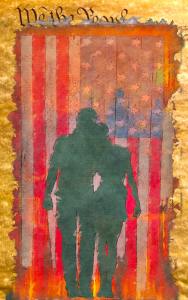
We the People - by Sarah Hoyt

We the People – by Sarah Hoyt

Trump has opened up discussion and encouraged speech from reasonable nativists, but also from formerly muzzled white supremacists and bigots of all kinds. His appeal is similar to the National Front in France: he has attracted nativists and middle and lower class people who have felt shut out by “respectable” social democratic parties. To analyze the commenters of a blog which shall go unlinked, responding to Sarah Hoyt:

[Sarah Hoyt] “Whether we were born elsewhere or here, Americans — those of us who are proud of the name — are rebels, revolutionaries, something new under the sun: a people who believe people should be equal in their right to life, the right to liberty, the right to pursue their happiness undisturbed by either inimical neighbors or oppressive “betters.””

Equality and Egalite are French Enlightenment abstractions designed to finish off the last of the Church, and to rationalize the totalitarian impulses and actions of The Mob . . . people like Sarah Hoyt.

Equality is a satanic concept and provides, in practice, the exact opposite of equity and fairness. Without ‘equality’ people like Sarah Hoyt don’t become successful, much less famous. They become instead what they merit, which isn’t much. They damn well know it, too, which is why they’re so full of vitriol — afraid of losing their vast, unearned privileges. Which they are going to lose, anyway.

Equality, like Women’s ‘liberation’, permits Sarah and her fellow traitors to crush their betters — yes, they DO have betters, and boy do they HATE HATE that — and take over nations under cover of helping the downtrodden and oppressed’. That’d Themselves and their friends, in case you’ve been asleep the past half-century.

Think you have Equality? Sistahood Sarah threatens to punch a mere male, and will not be punished if she does. Try punching Little Miss Virtue Signal and see what happens.

Liars and cowards selling their popular, self-serving lies, while patting themselves on the back for being Brave Rebels who are standing up to The Evil (non-existent) Patriarchy.

This is an interesting mix of “truthiness” and bigotry. Sarah is American by belief and choice, accused of being a “traitor” by people who think their ancestry and presence on the landmass of the US since birth make them guardians of the US nation-state. Aside from the incoherence (how can she be a traitor if she is not a member of the tribe?), the commenter attempts to other her by lumping her in with the virtue-signalling SJWs.

This commenter is sadly unAmerican in his resort to racist and sexist issue framing, completely misapplied to Sarah Hoyt. It’s unfortunate that the loud outpourings of these people, few in number but egging each other on in the fever swamps of sites like this blog-which-shall-go-unlinked, can so easily be used by progressive scribblers elsewhere to tar all dissenters from the Progressive program of thought control as racists, misogynists, and neo-Nazis (or worse!)

Which brings up a valid point these people have made: if Americanism is a bundle of individualist beliefs and attitudes, what about those with deep roots in the US, born and raised for generations there, who don’t accept those beliefs? If tolerance of difference is a watchword, then should those who don’t tolerate differences be suppressed or removed?

Our answer starts with looking at how we got to this point, where government has expanded and encroached on the private sphere of business and social organizations to the point where private action is viewed with suspicion, and a significant percentage of the population believes democracy means subjecting every action of business to the political process and regulation.

Americans were formerly known for their commitment to private charity and self-help organizations; the America of Alexis de Tocqueville in 1835 teemed with churches and private social organizations and lacked the inherited privilege and concentrations of unearned wealth and power seen in Europe. But he worried that “… a despotism under a democracy could see ‘a multitude of men’, uniformly alike, equal, ‘constantly circling for petty pleasures’, unaware of fellow citizens, and subject to the will of a powerful state which exerted an ‘immense protective power’. Tocqueville compared a potentially despotic democratic government to a protective parent who wants to keep its citizens as ‘perpetual children’, and which doesn’t break men’s wills but rather guides [them], and presides over people in the same way as a shepherd looking after a ‘flock of timid animals’. He also wrote that ‘The American Republic will endure until the day Congress discovers that it can bribe the public with the public’s money.'”

He was prescient. We have arrived at that state. Half the US population believes they are victims of the “malefactors of great wealth” demonized by FDR; FDR’s experiment in Democratic Socialism was derailed by his own nominally Democratic-controlled Congress by 1938, but enough remained of his expanded regulation of business and greatly-increased size of the Federal government to send the US down the road to permanent bureaucracy and a Deep State that constantly seeks to expand its power and resources. Eisenhower warned of the “Military-Industrial Complex,” but it’s no longer just defense contractors in league with Congress to pork-barrel spend, it’s a much larger group of special interests influencing legislation and regulation to give themselves protection from competition as well as direct access to public money. As governments have increased their control of all sectors of the economy, growth has slowed, prices have risen, and young people have found themselves in debt to an education complex which graduates them with few useful skills, then forced to buy health insurance at higher-than-market prices to subsidize wealthier old people.

Americans are largely still believers in the principles of Americanism — live and let live, equality under the law, free enterprise, and a civil society that ideally doesn’t discriminate by color or sex. But several generations of public schools, originally introduced on a Prussian model and intended to mold a population to more uniformly accept direction as cogs in a military-industrial machine, have weakened their resistance to collectivist thought. The Wikipedia entry on the Prussian education system says:

Early 19th-century American educators were also fascinated by German educational trends. In 1818, John Griscom gave a favorable report of Prussian education. English translations were made of French philosopher Victor Cousin’s work, Report on the State of Public Education in Prussia. Calvin E. Stowe, Henry Barnard, Horace Mann, George Bancroft and Joseph Cogswell all had a vigorous interest in German education. The Prussian approach was used for example in the Michigan Constitution of 1835, which fully embraced the Prussian system by introducing a range of primary schools, secondary schools, and the University of Michigan itself, all administered by the state and supported with tax-based funding. However, e.g. the concepts in the Prussian reforms of primordial education, Bildung and its close interaction of education, society and nation-building are in conflict with some aspects of American state-sceptical libertarian thinking.

In 1843, Horace Mann traveled to Germany to investigate how the educational process worked. Upon his return to the United States, he lobbied heavily to have the “Prussian model” adopted. In 1852, Mann was instrumental in the decision to adopt the Prussian education system in Massachusetts. Governor Edward Everett of Massachusetts instituted a mandatory education policy based on the system.[33] Mann persuaded his fellow modernizers, especially those in the Whig Party, to legislate tax-supported elementary public education in their states. New York state soon set up the same method in 12 different schools on a trial basis. Most northern states adopted one version or another of the system he established in Massachusetts, especially the program for “normal schools” to train professional teachers.

Americans were especially impressed with the Prussian system when they set up normal schools to train teachers, because they admired the German emphasis on social cohesion. By the 20th century, however, the progressive education movement emphasized individuality and creativity more and opted for a less European-inspired curriculum and lower social cohesion and uniformity. The Progressives faced a major setback with the Sputnik crisis, which led again to more focus on quality education and selectiveness of the school system. The derogatory use of the term may contrast 19th-century pedagogy (see the poisonous pedagogy debate in Germany) with the introduction of new technology into classrooms during the Information Age. While Joel Rose appreciates Horace Mann’s commitment to a public education but is aiming at renewing how to deliver it, authors like Conservative Party of New York State activist John Taylor Gatto and further home-schooling activist Sheldon Richman claim that illiteracy rates in the USA were lower before compulsory schooling was introduced.

Those “normal schools” to train educators are a primary source of the substandard teachers of today, taken from the bottom third of college applicants and trained to promote “correct” social thinking. Big city schools, especially, are run for the benefit of union teachers and not the students. Parents get little or no choice in their children’s education, children get limited instruction, and disciplinary problems detract from study.

But even in the better districts, a uniform Progressive ideology has gradually been impressed on the students. The elementary teaching generation after World War II was still fairly high-quality, and many bright young women went into it as a caring career which would allow children and family interruptions. The advent of both expanded professional opportunities for women and social pressure to go after higher-paid professional careers removed many of the most-competent people from elementary school teaching, and the newer generations of teachers have been trained to promote social ideals over knowledge, with less time for Western classics, civics and history, science, and economics, and more time for environmentalism and “corrective” diversity training. As a result, graduating students, while more sophisticated in some areas, lack the basic knowledge of government and history needed for American citizenship. They have been trained in Progressive ideals, including the notion that passing a new law can address every social problem.

Another import from Bismarck’s Germany: State Socialism. Bismarck set up the basic social welfare state as we know it, with state health insurance, pension, and disability programs, in the 1880s. Social Security was FDR’s similar effort to defuse the tide of full socialism in the Depression; by borrowing from the future, it could provide state support for the elderly at seemingly little current cost in payroll taxes.

These efforts to protect and provide for citizens via state programs have enfeebled private efforts to save and enter mutual support agreements. Half the population now believes they are owed a good job and a living through government action. Politicians speak about “creating jobs” as if that is their proper role, interest groups unashamedly lobby for more subsidies for their particular interest from the money tree of tax receipts and government borrowing, and the common political response to high-priced and low-quality housing in the coastal cities is public housing subsidies, rent controls, and “inclusionary zoning” (the requirement to build “affordable” housing as part of every market-rate project.) All of which drive down supply and increase costs further.

Many people see what’s happened and have tried to sound the alarm. But dissent from the program has been suppressed for decades. And now we have Trump and others feeding off the anger of those who have suffered under a system which rewards the connected and wealthy at the expense of the hard-working, blue-collar citizens not enjoying privileged coastal lifestyles. Our politics has suffered from the sound of silence — the supposed racist and sexist origins of all anti-Progressive efforts, the Conventional Wisdom of the mass media which filters out anything nonmainstream, the gradual corruption of the academy by government funding and directives.

The antidote to this encroaching tribal collectivism is electing representatives willing to return focus to the core function of government — defense, justice, and enforcement of contracts. Returning power to decisionmakers closer to the decision — state and local governments and private citizens — reduces the rewards of corruption and empowers the people to take responsibility for their own and their children’s welfare. Education should be funded by parents and local associations, not mega-school districts and Federal bureaucrats. Parental desires for their children’s upbringing should be respected.

What should not be respected are the non-American “isms” — belief systems incompatible with the Constitutionally limited government that made the US the desirable place to live for productive people. Racism, sexism, classism, Communism, Socialism, etc., should never be tolerated in the action of law. Dividing up citizens by skin color and tribe and doling out affirmative action rewards to the favored may have been justified for one generation, but now create more division than they alleviate. Islamists and other religionists who believe that government should enforce their religious laws even without the consensus of other citizens should never gain a foothold in our politics.

There will always be people living in America who disagree with one or more aspects of Americanism. If they follow our laws and support themselves, the US can accommodate some number of them short of a majority. But we should seek to screen them out when they apply for immigration, and refuse to support them with welfare payments and subsidies. If they find it more comfortable to live in a country that supports their beliefs, they should move there. And we are under no obligation to associate with them, employ them, or be kind to them.

As Sam Adams said on August 1st, 1776: “If ye love wealth better than liberty, the tranquility of servitude than the animating contest of freedom, go from us in peace. We ask not your counsels or arms. Crouch down and lick the hands which feed you. May your chains sit lightly upon you, and may posterity forget that ye were our countrymen.”


Death by HR: How Affirmative Action Cripples OrganizationsDeath by HR: How Affirmative Action Cripples Organizations

[From Death by HR: How Affirmative Action Cripples Organizations,  available now in Kindle and trade paperback.]

The first review is in: by Elmer T. Jones, author of The Employment Game. Here’s the condensed version; view the entire review here.

Corporate HR Scrambles to Halt Publication of “Death by HR”

Nobody gets a job through HR. The purpose of HR is to protect their parent organization against lawsuits for running afoul of the government’s diversity extortion bureaus. HR kills companies by blanketing industry with onerous gender and race labor compliance rules and forcing companies to hire useless HR staff to process the associated paperwork… a tour de force… carefully explains to CEOs how HR poisons their companies and what steps they may take to marginalize this threat… It is time to turn the tide against this madness, and Death by HR is an important research tool… All CEOs should read this book. If you are a mere worker drone but care about your company, you should forward an anonymous copy to him.


Genre Reviews and Commercial Reviewers

Kirkus Reviews

Kirkus Reviews


I normally just pay for one review from Indie Reader, who are the indie version of a Kirkus or Publishers Weekly-style institutional reviewer. These institutional reviews are typically paid for by the publisher, but because their reputation as unbiased reviewers is what keeps the review companies in business, they are valued as neutral reviewers, though there are hints of bias — one could speculate they shade their reviews to avoid crossing the Big 5 publishers, and so will tend to go easy on “big books” that a publisher intends to push hard. But any favoritism to heavy advertisers is light enough that you can be sure that a truly bad book won’t be recommended, and a recommended book will be at least competent.

If I’m a publisher of reviews, I have several goals that sometimes conflict. If I’m the New York Times Book Review, I know my reviews will be read for entertainment by a readership that skews high in literary education and income, so my reviews will tend to play to that audience, which is why genres like science fiction and romance have a hard time even getting reviewed there, and often starting with two strikes against the book. If I’m running a SF&F website, my audience is readers of the specific genre, and the review will assume familiarity with the conventions of the genre and compare the book with other similar works, rather than being based on how the average literary fiction reader would view them. And in narrower niches, like mil-SF or zombie fantasy, it is assumed the readers of the review start out liking this sort of story, with these sorts of characters.

So I was leery of spending my publisher’s money to get a Kirkus review done. The review was glowing, but without the coveted star that tends to get notice from other reviewers and purchasing agents. I was interested in how they had treated other genre books, so I did a quick survey.

It appears that in the past, Kirkus assigned reviewers who were less than sympathetic to the book’s genre and intended audience. This review made me laugh:

GHOST by John Ringo

Mindless, misogynistic military slaughterfest, a change of scene from the author’s usual military SF beat (When the Devil Dances, 2001, etc.).

A middle-aged ex-SEAL with creaky joints, a bad back and a wrecked marriage, Mike Harmon retired on 50% disability and opted to return to college. But when Mike—codename: Ghost—observes a young co-ed being expertly snatched off the street, he investigates, and discovers a warehouse from which Islamic terrorists are shipping kidnapped girls off to the Middle East. Mike frees two girls and kills many opponents. As another consignment of girls leaves, Mike hops into the plane’s wheel well and ends up inside a terrorist base in Syria, where the bad guys are preparing to rape, torture and kill the girls in front of a video camera on the theory that this will induce the U.S. to withdraw from the Middle East. Fortunately, Mike has a GPS phone, so he calls in. Decisive President Cliff orders a SEAL team to the rescue. But girls are already dying, so Mike goes in himself, kills bin Laden and what seems like half the Syrian army. Despite being shot full of holes, Mike hangs in until the SEALs arrive. For his bravery, he receives a monetary reward and later gets to indulge his sexual fetishes (bondage, dominance) with a couple of co-eds in Florida. In the Bahamas, he kills many terrorists, gets shot full of holes and receives much money. In Eastern Europe, he indulges his taste for rape, kills many terrorists, etc.

Disturbing and disgusting. An incentive to never read books again.

But other than that, how was the play, Mrs. Lincoln? This is Ringo. His books aren’t likely to be accidentally considered for reading by people like the reviewer, so the review is useless for deciding which violent testosterone-infused male fantasy adventure book to buy for people who enjoy that sort of thing.

One of the best writers of science fiction and fantasy, Lois McMasters Bujold, never got a starred review from Kirkus. Here’s the summary of their review of middle Miles Vorkosigan in Mirror Dance: “A well-conceived series, solidly plotted and organized, though heavy going in places and, finally, lacking that spark of genuine originality that would blazon it as truly special.” Kind of missing the point, no?

I was talking to my husband about this, and he commented that he discounted all science fiction movie reviews in major media until recently because most were so biased against the genre. The situation is changing as more younger reviewers who are steeped in genre get into reviewing positions, but it’s still hard to get respect for even the finest SF&F writing unless it comes with New York-style literary credentials.

Kirkus Reviews “Shrivers: The Substrate Wars 3”

Shrivers Kindle Cover

Shrivers Kindle Cover

It takes a long time to get one of the legacy review companies to review a book, so finally Kirkus has posted their review.

KIRKUS REVIEW

A third adventure in a sci-fi series follows idealistic rebels who can manipulate reality using quantum portals.

Ten years ago, college students Justin Smith, Steve Duong, and Samantha West led a revolution that invented quantum teleportation and used it to eliminate the Earth’s nuclear arsenal. Now, that same technology, which involves tapping “into the computational substrate that runs the Universe and determines how matter and energy appear to interact,” allows them to live on New Earth. This planet is just one of over 100 worlds humanity has settled throughout the galaxy. Thanks to less condensed populations, the watchful, artificially intelligent Guardians, and replicator programs that provide food, shelter, and clothing, “crime and hunger are almost unknown.” Trouble arises, however, when decimated alien civilizations begin appearing in galactic surveys. Because Justin, Steve, and their programmers can’t find any thriving alien races, they suspect that another intelligence is manipulating the substrate. When Eddie, an artificial intelligence, makes itself known to Kat, Justin and Samantha’s 10-year-old daughter, dire truths trickle in. A race called The First, which lives immortally within the substrate, decides which civilizations get to upload and join it. Determined to test humanity, The First now sends its Shrivers—an AI death squad—toward every planet that the revolutionaries helped settle. Kinnison (Nemo’s World, 2015, etc.) bursts wide the scope of his continuously rewarding series in this latest entry. As in the previous novels, he challenges his characters to evolve morally as well as technologically; when Justin and Steve appear secretive about the discoveries on an alien ship, NASA astronaut Maddy Rahama reminds them why they fought the United States when she says, “I thought you guys were going to be the most transparent government ever.” Keen sociological insights are crucial to the plot, as when Justin says, “Just because no one goes hungry, doesn’t mean people stop envying and hating.” The narrative, despite approaching war, proves riveting in the classic mold of Isaac Asimov and Robert A. Heinlein’s works, in which action never eclipses heart and intellect.

A novel about a galactic threat that offers an addictive barrage of lofty ideas infused with soul.

Pub Date: Nov. 25th, 2015
ISBN: 978-0-9961833-2-1
Page count: 360pp
Review Posted Online: Feb. 24th, 2016

Shrivers: The Substrate Wars 3


“Shrivers” Reviewed by Jimbo’s Awesome SFF Reviews

Shrivers Kindle Cover

Shrivers Kindle Cover

This review turned up this morning. This guy gets it!:

…Have you ever missed your stop and had to do extra walking on tired feet because you couldn’t wait to see what was next? Your latest book, Shrivers: The Substrate Wars 3 had me hanging on every word. It’s hard to watch out of a window to see how close I am to my stop when my nose is stuck in an e-reader.

*SIGH*

Seriously folks, this is a good one. Fans of the site (both of you) will remember that I have reviewed both of the first two books in the series, The Red Queen and Nemo’s World and enjoyed them both but this is easily the best of the three. Once again we see the fight against Big Government and a crackdown on the dirty little guy, this time on an existential level. It’s not even about a human government anymore. This one is all about the fight of humanity to survive against a force that is regulating the substrate. If you don’t know what the substrate is, it’s because you haven’t read the first two books and that is a mistake you need to fix quickly….

As a fan of Science Fiction and Fantasy, one of my favorite things is an epic plot and an existential threat. Kinnison got both of those into this book in spades. The Red Queen was about a renegade group of students rebelling against oppression. That’s good stuff. Nemo’s World was about setting up a government and what to do with dangerous criminals. It was a lot of fun as well. This one is not just bigger than either, it’s bigger than both put together. The impressive part about the whole thing is really about how well Kinnison humanizes it though.

The previous cast of characters is all still here and they’re all doing their thing. Some are perhaps a bit older, wiser and more mature but things tend to work that way in real life so that’s hardly surprising. What is incredibly surprising is the inclusion of a young girl on whom the fate of the entire human race depends. Whether she is up to the challenge or not… well… read the book. I don’t do spoilers. I will say that she gets put into her position because she is a unique young lady and that the decision is not made by a human being. Humans have friends among those who would try to kill them. And that’s one of the things that I really, really enjoyed about this book.

Look, I’m okay with a cardboard villain if it fits the story. Battle: Los Angeles was a good movie that pretty much went “The bad guys are here to steal water and they’re going to kill us all to get it,” and left things at that. This book is not that way. Kinnison’s villains are every bit as much motivated as they are dangerous and they have very clear motivations that MAKE SENSE. I get the fact that alien reasoning may not always be obvious to a human mind, especially given the fact the motivations of a person from another human culture can be opaque at times. Still, the enemy, known as the First because they were the first culture to discover the substrate, is looking to perpetuate their own existence against anyone they see as a threat. New species are, to them, a threat to take up the space they need to live.  The Shrivers that Kinnison named his book after are their method of doing so.  Nuclear annihilation awaits those that aren’t unique and impressive enough.

I have to admit that I was a bit skeptical about the ability of anyone to wipe out an enemy that has access to the substrate when I first read about it. That lasted until I had read a little further. It turns out that there is a fairly simple way to mess with a computer program (a virus) and that a society who has had access to the substrate for billions of years is better at using it than we would be. Go figure. It works here though because it’s so familiar. I had missed the possibility but the reasoning was sound and it made the story easy to follow.

This tome cooks from beginning to end. It just doesn’t let up. Problems come up and are solved just in time to set up the next round of problems… The politics of the story drift a bit in the work as well. At first it was a plucky bunch of kids rebelling against an overreaching government. Then it was those kids a few years later finding a way to turn things into a government in which everyone has a say. Those were impressive. But now things are shifting a bit. Control of the substrate is control over the future of humanity and its use is restricted to just a few people who are planning to pass that control on to their children. This has potential to lead to a government even more repressive than the one they overthrew. So far they haven’t gone down that road but the possibility to do so is certainly there. If Kinnison will steer his series away from that eventuality. If he does so it will be interesting to see how he pulls it off. So I’m waiting (im)patiently for the sequel to see what comes next.

Bottom Line: 4.75 out of 5 Micro Black Holes

The first book of the series (Red Queen) is on sale for $0.99 here. The second book, Nemo’s World, is here, and Shrivers (the one Jimbo is reviewing) is here.

Or you can buy all three as a Kindle bundle for $6.97 here.

IndieReader Reviews “Shrivers: The Substrate Wars 3”

Shrivers: The Substrate Wars 3

Shrivers: The Substrate Wars 3

First “professional” review in — rather short.

Humanity’s attempt to survive first contact with a civilization that reaches back to the early days of the universe in: SHRIVERS

By Jeb Kinnison

 star star star star star 

IR Verdict: Somehow both contemplative and exploding with action, SHRIVERS is an engrossing story that shines a light on humanity’s best and worst aspects as a fleet races to wipe them out.

“Instead of relying on outlandish technology or eccentric alien species, Kinnison has crafted a futuristic world that touches on philosophical, moral, and ethical ramifications of survival.”

Humanity has finally found peace among the stars thanks to quantum gateway technology, replicators, and powerful AIs. Before the dust can settle, the riddle of the Fermi Paradox is answered in the worst way possible. All advanced civilizations are uploaded to a virtual realm, or completely eradicated. And humanity is on the chopping block.

SHRIVERS is the third book in the Substrate Wars series. 10 years after Justin Smith and Steve Duong invented quantum gateway technology, humanity spread to other planets in an era of peace without want or violence. After exploring destroyed world after destroyed world, a race known as the Shrivers target humanity for extinction. With a deadline on the clock, Justin and Steve race to prepare for the Shrivers’ arrival. Meanwhile, an emissary from the civilization hidden in the virtual realm (known as the “Substrate”) contacts Justin’s daughter and prepares her to speak on humanity’s behalf to the tribunal that decides all advanced race’s fate.

In a refreshing entry in a science fiction series, SHRIVERS excels at examining humanity’s growth into the wilds of space. Instead of relying on outlandish technology or eccentric alien species, Kinnison has crafted a futuristic world that touches on philosophical, moral, and ethical ramifications of survival. Of course, the tech and aliens are nothing to sneeze at. The use of AIs known as Guardians to curb violent acts, instruct and educate, provide all necessities, and function as humanity’s allies is engaging and intriguing. SHRIVERS is a captivating entry in the series and a stellar piece of sci-fi.

Somehow both contemplative and exploding with action, SHRIVERS is an engrossing story that shines a light on humanity’s best and worst aspects as a fleet races to wipe them out.

~ IndieReader.

Shrivers: The Substrate Wars 3


Amazon Responds re Review Erasures

The Library

The Library

My last post was an open letter to Amazon head Jeff Bezos. Today I got a call from an “Executive Customer Relations Specialist,” a nice young man who explained what he could find out about the incident. We talked about their review problems for some time, and I continued thinking about it long after (as usual.) So of course I couldn’t resist writing them a memo:

[This message is intended for Bnnnn Bnnnn, ECR, but I have no direct email for him.]

Bnnn —

Thanks for taking time out to talk today. Our conversation has triggered a lot more thought, and since I now know you may actually be able to convey some of what we’re thinking out here back to the people who decide these things, I am writing in the interest of improving Amazon and self-publishers’ cooperation.

Why You Should Listen To Me – Qualifications

[Various accomplishments and credentials omitted] I was one of your earliest customers, perhaps back around 1995, and I have been a big supporter, doing an increasing amount of business with you over the years. I managed the investments of [tech guy], founder of [bubble-era company name], during and after the dotcom bubble era, and came away with [large sum of money], so my book earnings in retirement are not critical to me — unlike some of my fellow authors, who depend on Amazon sales for much of their income, and are too afraid to speak up to you in public. In my role as portfolio manager, I became quite familiar with e-commerce and marketing.

Market Trends

Amazon is a key actor in the restructuring of publishing and general retailing, disintermediating and lowering the cost while increasing selection of goods. Books are especially suitable for this, since they are not commodities — each book and its reader/buyer have a different relationship, and there’s no simple linear scale like star ratings which can predict how satisfactory the book will be for that reader. Formerly publishers treated books like produce — with a big marketing buildup, often with paid or negotiated display space in bookstores, and a short shelf-life, with the unpredictable return rate adding to risks and costs. This led to fads and copying of trends, flooding the market with books similar to previous bestsellers and shutting out some quality books that were less commercially promising.

We understand why legacy publishers want ebook prices to be very high, often higher than print — they control the print model, which can be very profitable still, and want to slow the disintermediation restructuring, which leads to a world where they have a lesser role. This is damaging the quality of books produced by their system, and their low-paid lower level employees keep out a lot of fresh new perspectives, especially if they’re not in agreement with their politics.

The future is with online groups of readers who cross-recommend books to each other. Online communities are not likely to promote crap books like those that make up 95% of Amazon’s new books catalog. All of us online have our own reputations to guard, and we don’t push stuff on our readers that they are unlikely to like. Amazon needs to encourage this kind of community.

The Problem of Crap — Book Discovery in an Age of Excess

We all know you have too much bad material on Amazon — quite reasonably, how could you judge quality with an automated process?

When I started relying on Amazon for books, you emphasized your algorithm for recommending suitable books based on the ratings of the reader for other books they had read. This has disappeared, and you recommendations are useless now. I relied on the list of new science fiction books you made available, and bought from it based on author’s reputation, “institutional” reviews, and lastly customer reviews. This is not working at all now, as there are far too many new books, some of the best writers are self-published, and the Big 5 push less quality stuff; most small and self-pubbed writers can’t afford the delay and expense of Kirkus reviews, and the other big reviewers refuse to review us. The gatekeepers have narrowed the gate so much that many quality writers can’t get through. Meanwhile, voracious readers of genres like Mil-SF can’t find enough to read, and often end up buying low-priced books that are barely literate to keep their habits going. Genres like Romance and Mil-sf are a big part of your ebook sales, and are very poorly served by the Big 5 — not enough books in some niches are legacy-published to satisfy reader demand. This situation will only get worse as your review policies make it harder for us to meet that demand by making it harder for us to get new books off the ground with enough reviews to round out the customer’s knowledge of whether that book is likely to satisfy.

Misuse of Customer Data – Violating the Customer’s Trust

I respect Amazon as one of the most ethical companies, working hard to make the customer’s lives better. This image was gained by being exceptionally careful to fight for customers when short-term profits might have been easier by agreeing to supplier’s demands. You risk that image, though, when you use private customer data in the interest of anyone but that specific customer — it simply does not fly that you can trace customer’s relationships and injure them as a result of your desire to protect the review system’s integrity. Using customer data to inform that customer about products they might interested in is fine; using it to erase the reviews they spent time and effort to share on your system is damaging to customer trust and results in strange advice like “don’t send de minimis gift books via Amazon to your literary group, it will forever bar them from reviewing your work.” It’s quite creepy and damages your image, the kind of damage that eventually leads to government regulation or antitrust issues.

Better Ideas – Some Problems and Solutions

Problem — fake reviews, generally paid-for. If anyone can review a product at Amazon without proof of purchase, then there really is no way to stop this entirely. The two ends of the problem can be addressed: 1) any account that has generated unusual numbers of extreme positive or negative reviews can be warned, then barred from reviewing if it doesn’t stop, and 2) reviews from verified purchases can be given display and rating priority, which I understand you’re rolling out now.

Problem — Helping new authors get real reviews, because they absolutely have to have a way to distinguish their good product from the flood of crap. You are actively damaging us now, but you could implement a system allowing a book’s author to send out codes redeemable for review copies, then let the reviewer use that code when entering their review to give it the flag “This item was reviewed in return for a certified review copy.” This neatly solves two problems: our difficulty getting DRM’d review copies to reviewers, and your fear that we will only select favorable reviewers. The reviewers can be watched and rated using your account system, so that those who are good get higher weights, and those who regularly trash everything or five-star everything get low ratings. Currently NetGalley has this market sewed up, but at high prices most authors can’t afford — $150 or more per book. You should displace them and give more support to the small and self-publishers that are your future suppliers.

Problem — review “skew.” Where an author’s successive works get higher and higher ratings, because as a known quantity, those buying his/her books are more likely to be previous readers and fans who already like that writer’s work. I’m noticing that now, where the list of people who agreed to read the ARC of the third volume of my series tend to like my work already, and gave it a higher rating than a more randomly-selected previous groups which included more science-phobic readers. But this is actually not a problem; it is the expected result of consumer preference and a writer’s reputation. That writer clearly has readers who love that style, and if the rating attracts a new reader who hasn’t read the reviews and noted how science-heavy those books are, then that reader may be disappointed. But you’ve protected them as well as you reasonably can.

So, recommendations:

— As you are already doing, weight product ratings according to likely reliability of reviewers,
— Additionally rate reviewers themselves, to weed out the bad ones and give the best more weight in ratings.
Stop erasing reviews because of de minimis connections, which abuses your access to customer data. At most put a disclaimer tag on suspect reviews and underweight them in overall rating.
Implement a “review copy” code system, which authors can use to send out review copies. These reviews can be quality-controlled statistically and help good authors gain enough sales to eventually have a larger number of organic customer reviews.

These recommendations are based on the special nature of the ebook market, but some of them can also work for physical product reviews, like keeping ratings of reviewers as a weighting factor.

Gift idea: “Red Queen” – FREE for Five Days

Red Queen: The Substrate Wars 1

Red Queen: The Substrate Wars 1

Amazon only allows me to give away a book for five days a quarter. From today to Dec. 20th Red Queen is free on Kindle (it’s always free if you subscribe to Kindle Unlimited!) Would be a great gift idea for those of you who are thoughtful but temporarily short of cash, but I checked and the usual “buy as gift” button — which lets you buy a code the recipient can use to get the book — is removed when the book is free. Scrooge would be proud.

The rest of the series is, as usual, priced at $2.99, which is not much for so many quality words. Those you can give as gifts, or spring for the sumptuous trade paperbacks — not cheap at all, but look better under the tree.

As a new school year ramps up on campus, Justin Smith began another day at the Artificial Life lab running ALife simulations on human evolution. The lab was a sanctuary from the political divisiveness on campus and, for that matter, across the nation. A nuclear terrorist attack in New York City some years ago resulted in a government crackdown on dissent as well as a depressed economy where educational grants were drying up except for those labs who ‘cooperate’ with the government. However, Justin’s lab was soon to transform itself from a sanctuary to the center of resistance to the government… [with the] discovery of a computer program so powerful that it could be weaponized, tilting the balance of power even further into the hands of an already repressive government. The race to keep this mega weapon out of government hands leads Justin, Steve and a small cadre of students to secure the weapon and fight for their freedom from a tyrannical Dept. of Homeland Security.

Free for five days on Amazon Kindle. Feel free to pass it along!

New Review: “Nemo’s World: The Substrate Wars 2”

Nemo's World: The Substrate Wars 2

Nemo’s World: The Substrate Wars 2

This review of Nemo’s World just turned up on Amazon, and since I’m a Facebook friend of the reviewer (who tries to read and review lots of work — that’s the extent of our relationship!), I’m copying here in case the Amazon algorithms strike again and erase it:

5.0 out of 5 stars
A wonderful book about SCIENCE MAGIC and how real people react. BUY IT NOW!
December 14, 2015
By Pat Patterson

This IS, by golly, a review of the second novel in the series, and it’s name is Nemo’s World. I say that, because somehow I convinced myself that it was Red Queen. No, you dope, Red Queen is the FIRST novel in the series, and you reviewed that in September. /end apology for being a dork/

This is a SCIENCE book about PEOPLE. It is not a ‘meanwhile, back at the asteroid’ book, which merely transmits Perils of Pauline into outer space. It is also not a ‘gee-whiz, look at the quasar explode!’ book, which only uses the people to discuss something esoteric. It is, instead, a well-written book about what real people do when they encounter technologies which have the capacity to free or to imprison or to destroy. The technology itself is ethically neutral; it is the character of the people that determines whether or not the outcome results in the maximal value of goodness in the universe or not. You know that bit about sufficiently advanced science being indistinguishable from magic? That could easily happen in this book if the author just used hand-wavium. However, a good bit of the first third or so of the book is given over to explaining just how all this works. So, take heart: you do NOT have to have advanced studies in physics to understand what’s going on in the book. And, if you really don’t care, just skip over the explanations like you did during the whaling parts in Moby Dick.

The characters are carried over mostly from Red Queen, with some new additions. In my humble opinion, however, they aren’t the SAME characters, because they change in light of new developments.

The principal technological applications are a result of discovering how to use the underlying structure of the universe (the substrate) as a source of computation and power. The two most significant applications are first the ability to create windows into other distant locations, and second the ability to create exact replications of physical objects. Thus, we have infinite or near infinite growing room, and infinite resources. In the world of intense government control described in the first book, this is an immediately destabilizing factor.

Okay, I want to shift to what I believe is the most interesting ethical question posed by the technology, which is the replications of human beings. Steve is the genius behind the discovery and development of the new technology. Whether or not it is required that his type of genius also be socially inept is not clear, but Steve is certainly found to be pretty far along on the Aspergers/autism scale. It’s actually quite a beneficial characteristic for him to have, at least in the early stages, since he hasn’t been talking to other people about what he has discovered, and also because he pretty much ignores everything around him in order to enjoy his work. And, to be greatly specific and intentionally offensive, he don’t seem to care for chicks. HA HA! As it happens, there is a certain young lady from the sub-continent of India who DOES care for him! And whether or not he notices, she acquires him by the provision of moving into his tent. I feel relatively certain that Steve had SOME input into the arrangement, but it is clear that Rasna is the active agent here, and it is a Good Thing. And, when you add a Good Thing to a Bad Thing, then you get a Some Thing!

Here’s the Bad Thing: There is so much essential development which must be handled immediately, and it can only be handled by Steve due to his brilliance and grasp of theory, that he simply can’t handle it all. It simply CAN’T all be done, yet it MUST be done, and it means that Steve doesn’t even have a chance to eat or sleep, much less explore his relationship with Rasna. So, he uses the replicator, and creates another Steve.

In public, they use the fiction that this is Steve’s twin brother Larry, just in from Viet Nam, who speaks very little English. It works, for the public.

But MY immediate question is this: since the Larry is the same as the Steve, does he not have equal standing? And specifically, what is relationship with Rasna? Sure, share the work; that presents only minor problems. But share the companion? Rasna reveals that she can’t tell them apart, but states that she doesn’t care, as long as it’s the original she’s sleeping with.

How does she know?

And what about the Larry/Steve’s position on the matter? He has been completely replicated, which means he emerged from the replicator with the same emotional set-up and memories of Rasna as Steve/Steve; isn’t denying him the pleasure of her association the ethical equivalence of denying Steve/Steve?

As I was reading this, I thought, Maybe this is a third application where Steve’s Asperger’s is going to be a benefit. Perhaps he really hasn’t bonded with Rasna at all, so emerging into being without the physical requirement to spend time and energy with her is going to be seen as a plus, and not a minus. Maybe you can replicate geniuses with Asperger’s at will, and never suffer any social complications.

But then it occurred to me: why not replicate Rasna, and call her something else, like Shakuntala, the warrior empress from the Drake/Flint Belisarius series, and pair her up with Larry/Steve?

Aha!

BUT: Rasna does NOT have Asperger’s! And neither would Shakuntala/Rasna, and so what would be the likelihood that she would ALSO demand to be the only one to sleep with Steve/Steve?
He he.

Okay, Jeb Kinnison, how are you going to write your way out of THIS mess?

The small group who program the new technology recognize how much trouble it would cause to have human copies, so they write the programs for normal use to recognize and prevent copying of living things. Steve’s use is a one-off, with the alternative — opening up direct substrate programming to more programmers — viewed as too dangerous to allow. The plot in the next book requires restoration of a lot of backup copies of people, and so the issue will have to be faced. As with all powerful technologies, there are compelling reasons to use it, and real dangers as a result…

Rasna accepts Steve for who he is, and revels in taking care of him despite his limitations and absorption in his work — this has been a pattern for lots of great scientists, and many partnerships are founded on complementary personalities like theirs. You’re quite right that copies of Rasna would find it more difficult to accept the situation, and over the longer term, the copies of Steve may well deserve equal status and a Rasna-copy of their own, likely by moving to another planet to avoid confusion!

If you haven’t read the first in the series, Red Queen: The Substrate Wars 1, it’s best to start there.

Open Letter to Jeff Bezos re Review Erasures

Another data point for the self-pubbed dealing with Amazon’s paranoid reviews policy. I uploaded the latest Nov. 25th, and by Dec. 1st had eight 5-star reviews from the 20 or so people I had emailed ARCs to. Amazon deleted the last three reviews, all posted on the same day, claiming they had found “associations” between the accounts. I suspect it is a dumb algorithm that assumes too many 5-star reviews too quickly must mean they are paid, and that Amazon is lying about it.

Here’s their boilerplate language:

We removed the Customer Reviews for your book because our data shows elements of your Amazon account match elements of the reviewers’ Amazon accounts. In these cases, we remove the reviews to maintain trust in our customer reviews and avoid any perception of bias.

Customer Reviews are meant to give customers unbiased product feedback from fellow shoppers. Because our goal is to provide Customer Reviews that help customers make informed purchase decisions, any reviews that could be viewed as advertising, promotional, or biased will not be posted.

Here’s my response:

I have read your guidelines thoroughly and note “family and *close* friends” is the standard you cite to disallow reviews. I share your desire that reviews be unbiased and fair across products. I question your commitment to achieving this goal when you will not remove obviously fake one-star reviews which have been posted by competitors or people who dislike the book’s author for political reasons.

First let me comment that I bring Amazon significant yearly revenue on my books, audiobooks, etc. My family also directly spends about $10K per year with you. You have set up an algorithm which uses poor guilt-by-association correlation data to intentionally wipe out the hard work of Amazon customers who take the time to review my works, which damages my perception of Amazon, and as we the authors make our stories known, will damage your other customers’ views of your company.

Self-pubbed authors must make more efforts to keep in touch with their fans to have any chance of succeeding in a marketplace dominated by legacy publishers who are allowed to promote their products by direct payments to Amazon. Your efforts to give small press and self-pubbed authors a way to advertise are complete failures. Amazon has allowed legacy publishers to overprice their ebooks, pay you for what appear to be endorsements, and game the reviews system with large numbers of paid reviews for their products.

Frankly I think you are lying. You have implemented a review-cancelling algorithm which in my case appears to have been triggered by “too many” 5-star reviews in a short time, since you cancelled the last three out of eight, and those three are fans of my writing, not family or *close* friends as you specify in your guidelines. I think it is just accidental that all eight of my first reviews were 5-star, though it’s possible it’s just that good a book.

You have damaged our relationship. I request a re-review and restoration of those three erased reviews.

The erased reviews, (all 5-star), and not a hyped or misleading one in the group:

1) Stephen Marino reviewed Shrivers: The Substrate Wars 3
I very much like the story – December 3, 2015

First let me start with the disclaimers.

1, I helped workshop part of this story at Taos Toolbox.
2. I was a beta reader of the completed work.
3. I very much like the story.

Because I am giving this story all five stars, let me state why you should not read it.
Do you like to think for yourself or do you want every little detail of what is happening spelled out for you? If you only like to read fluff, this is not your book. I am not saying, it is a hard read, just that it is many layered. Pay attention to the sub subtexts.

Do you only like to read books from authors who have no understanding of technology and the effects it can have on society? If so, there are lots of writers who don’t know what they are talking about.

Have you read the previous books in the series? If not, You will probably enjoy the book more, if you start with Red Queen and move on to Nemo’s World. The story stands alone nicely, but a bit of background can be a good thing. (You can’t unread book three before going back to read 1 and 2.)

What are the books about? Spoiler free, this universe is a big honking computer simulation and in about 20 years, a few university students begin learning to program it. The world is beginning to go in a very dystopian direction and war breaks out between the students and the world’s governments.

I know this has been said by everyone who has read this series, If you enjoyed Robert a. Heinlein, You will greatly enjoy this author.

2) Bookgirl reviewed Shrivers: The Substrate Wars 3
Engrossing addition to the Substrate Wars saga – November 30, 2015

Shrivers are coming.

Complex plotting, political intrigue, and a galaxy­spanning saga. Shrivers builds relentlessly to a climax filled with surprises. Kinnison weaves multiple plot lines, characters, and different planetary settings together adroitly, crafting a tale that will captivate and delight hard science fiction fans.

3) M. Cunningham reviewed Shrivers: The Substrate Wars 3
Captivating read – November 30, 2015

I was provided an advanced reader’s copy for review and found it to be a captivating and entertaining read. Mr. Kinnison has channeled his inner Heinlein to create a fitting wrap­up to the Substrate Wars trilogy. I was especially impressed by the creative use of Kat’s training in the virtual reality world of the substrate to create stories of how other aliens lived and reached the substrate. I would highly recommend this book to anyone who appreciates the golden age of science fiction.

1) Properly discloses the relationship with the author. But it is a competitive relationship, and he is not my friend, much less my close friend.

2) No idea who “book girl” is, probably one of the 8-10 book bloggers I sent an ARC to for review. Arm’s-length.

3) Fan who has reviewed previous books and so was willing to read the ARC. Gave the previous books 4-stars, so not a pushover.

So stop lying about supposed “elements matching” — no such elements exist, though in the case of #3 I sent him a paper copy so that might appear in your search. The others have NO CONNECTION WHATEVER in account records.

Stop lying. Restore the reviews. Or authors and readers will turn on you. Why should customers make an effort to review books when you may arbitrarily erase their work?

A comment on Facebook:

I’m guessing they don’t want to admit that one of their computer guys has run a correlation study and suggested a simple “too-many-five-stars-too-quickly” screen. That might cut fake reviews down, but also cuts legitimate ones. And it’s embarrassing to admit they can’t come up with something more sophisticated. People are worried about them tracing Facebook and email list connections, but I’m pretty sure they have no access to that data… and apparently authors signed up with Amazon press labels are immune (hi, Robert Bidinotto!)

copied from createspace groups:

10. Aug 5, 2015 11:32 PM in response to: lipmag
Re: Amazon reviews – petition

The issue I have with Amazon’s review policy is that it does not accurately apply across the board. Yes I understand the need to ensure authors are not padding reviews otherwise the reviews will hold no value to the potential customers however, with my latest release Amazon Amazon randomly decided to remove 2 reviews generated through ARC releases. The only response given when queried as to why was that the reviews violated policy because they believed the reviewers knew the author. They knew of the author, obviously, but these were not friends and family. Additionally, upon review of the posted Reviewer Policies the only sections that could apply (though they do not) are

• Sentiments by or on behalf of a person or company with a financial interest in the product or a directly competing product (including reviews by publishers, manufacturers, or third-party merchants selling the product)
• Reviews written for any form of compensation other than a free copy of the product. This includes reviews that are a part of a paid publicity package

The reviewers were not compensated nor do they have a financial interest. This brings me to my original point. They do not apply the guidelines across the board. I have never heard complaint from a large publisher that an ARC review was subsequently removed. In fact, many large publisher purchase reviews as part of their marketing plan (a direct violation of the above guidelines) and those reviews are rarely, if ever, pulled.

The entire process seems to a) not follow the published restrictions and b) be enforced in a discriminatory fashion. In my experience questioning Amazons decision or pointing out that the guidelines were not broken has no effect. In the end the do as they please.

— R. C. Butler – Bulldog Press

Other stories on the topic:

Amazon Review Policy Under Fire: Indie Authors Call For Change In ‘Big Brother’ Policing

Amazon’s Review Policy is Creepy and Bad for Authors

Amazon… A virtual marketplace, or Big Brother?

Petition on Change.org – Change the “You Know This Author” Policy