Publishing

Selective Outrage and Angry Tribes

Outrage Porn

Outrage Porn

What I call “outrage porn” is stories designed to stoke outrage and make you feel passionately that your group (us) is righteous and some other group (them) are not just misguided or ignorant, but actively evil and out to get the Children of Light (us.) The “porn” in the phrase means something that irresistibly attracts you by appeal to your baser needs, but is ultimately bad for you and false.

I’ve been mostly a spectator to the storm of media and blog posts about Sad Puppies (abbreviated herein as “SP”) and the Hugos. Old-line insiders resent barbarian hordes seen as uncouth, and probably evil, who have attracted a large number of science fiction readers who never realized they could nominate and vote for the Hugos by buying non-attending memberships to the Worldcons.

When you have tribes of highly-emotional partisans competing to support the side of Goodness, it should be no surprise that some of their words, taken out of context, can be used as material to discredit their fellows. The Insiders have their less-good eggs, and so do the Puppies; but *of course* these extremes do not fairly represent the views of either side. I’m not going to go over the controversy itself here, but point out one of the mechanisms that drives this kind of religious war online.

The Internet brings traffic to those who write something unusual and passionate that confirms the beliefs of (or frightens) the readers. Those passionate if less accurate writings are more noticed and more clicked on, and a whole raft of flash media sprung up the feed the attention beast through “clickbaity” headlines hinting at threat or passion if the reader clicks through (and drops a few ad cents into the site’s coffers.) Underpaid young grads are employed to read the news (both real and faked) and generate parasitic stories with no original reporting effort that can drive profitable traffic to the site.

Within that species of site you have even more specialized sites that cater to a single tribe, and offer up only stories that confirm the righteousness of that tribe and the evil of others. Partisans will subscribe to a selection of the sites that provide them with the most ego-satisfying stories that confirm their existing beliefs, and so see a world where most good news about people cooperating to do good things is blocked and the news about their enemies and activists is nearly all they see. Where once such sites filled a need to see news on topics not being covered at all in the mainstream, now they isolate and infuriate partisans, who are then easily manipulated by anger and a sense of grievance to give more power to the professional grievance mongers.

Once you recognize this syndrome, it is everywhere you look. Entrepreneurial activists like Al Sharpton and Jesse Jackson figured out how to fund their organizations through extortion, subtly picking corporate targets to demonize when they weren’t supportive, and ignoring those who were; eventually their faction edged into power and arranged for settlements in Justice Dept. suits against major lenders to include large grants to their affiliate organizations, which actively assist candidates of one party in elections. This is political corruption, and rarely even noticed by mainstream media.

But this is not a phenomenon limited to leftist activists. When Hillary Clinton blamed the “vast right-wing conspiracy” for the real and imagined slanders against the first Clinton administration, she was not entirely wrong. While her complaint had the flavor of a Scooby Doo villain’s speech (“We would have gotten away with it if it weren’t for those meddlesome kids and their dog!”), a new media complex was already mining their real scandals and imagined crimes for material to satisfy readers and listeners, with ever-more-extreme allegations being rewarded by True Believer traffic and dollars. Similarly, a complex of organizations dedicated to stoking anti-gay beliefs and stopping gay rights laws mined the ample material provided by gay organizations for the most outrageous and thoughtless material, suitable for ginning up passions in social conservatives and traditionalists, and the more extreme organizations simply made things up as necessary to demonize all gay people.

After many years of being subjected to this kind of abuse, some gay people were permanently polarized to see all religion and all traditional ways of living as their enemies. Specialized sites now feed their prejudices with every possible instance of unfair or ignorant abuse any gay person anywhere receives. So programmed, many gay people are both unforgiving and happy to assume any religious person is out to get them, and happy to see the newly-Progressive state crush grandmotherly florists and cake decorators to punish any trace of badthink.

If you want to see what this filtering does to a worldview, take a look at Joe My God and especially its commenters, where you’ll find the harshest partisans of gay rights (and gay revenge.) Also worth a glance are Gay Star News, Queerty, and The Gaily Grind. For the feminist-victim complex, there’s Jezebel, Feministe, Feministing… and much of the Huffington Post.

Here’s an example of the kind of unconscious prejudice this leads to, where a friend of mine cites a deadly brawl between a religious family and the police as evidence that all religion leads to evil and should be suppressed:

Clearly, these religious nuts don’t need any help showing the world exactly who they are and what they stand for. But, we should continue to share these and other stories widely, so we can keep the pressure on. More and more Americans are becoming aware of the hideous, unconscionable actions perpetuated in the name of religion. Sharing the actions of the evil-doers are the most powerful weapons we have against religion.

Video captures chaotic brawl in Walmart parking lot

The Cottonwood, Arizona police department released a video that appears to show an officer shooting a man. Police say a chaotic brawl broke out between polic…

This assertion of guilt-by-tribal-association is invisible to a partisan. One technique to get them to see the fallacy is to replace the religion with Islam, currently protected from the harsh judgement of Progressives by its status as the religion of “victims of Western imperialism.” If the group fighting with the police had been Muslim-affiliated, you can be quite sure that no progressive would think to tar all Muslims as sharing in the blame for the crimes.

For a second example from yesterday, I’ll turn back to Sad Puppies and the Establishment reaction to their success. Author Jack Dann, who by all accounts is a decent, right-thinking fellow in Australia, picked up and promoted a post citing selected quotes from your typical testosterone-laden exchange as representative of all Sad Puppies:

I’ve been told, repeatedly by one pleasant person, and by a few others, that Brad Torgersen, and the Pups are not horrible people, and that they can be worked with and that really they want a good outcome, and I try to see that, and then they show me otherwise. Here are a few quotes from the Pups over on Brad’s blog that I glanced at this evening.

  • If you think for one nano-second that we won’t burn this mother fucker to the ground and roast marshmellows over the corpses…. you’re dead wrong… And if you think we give a tanker’s damn about your appeal for civility…. you’re also dead wrong.
  • Hell… We may nuke the Nebulas too… just because.
  • We will burn it to the ground, plow the ground, and salt it. You fuckwads don’t understand war. We do.
  • in my opinion, Theresa Hayden’s parents were both: a.) circus people; and b.) first cousins.
  • Try to come up with something better, turdnugget.
  • I really don’t care about the Hugos, qua Hugos, to any measurable degree. I don’t care if I ever get one and I don’t really care if anyone else ever gets one, either. Rather, I care about the war in which they are just another front.
  • Scuttle back underneath the kitchen sink, and rejoin the rest of your chitinous cohorts.
  • The endgame, besides using your guts to grease our tanks,
  • Heeerrrrreee pussypussypussypussypussy.
  • Vox isn’t a side show, he’s just the warm up act.

And then the following, made by a lead Pup, in response to a person, who without profanity or insult, disagreed. The comments were made while the Pup was claiming to be tracking down the home of the person who disagreed:

  • Hey, anyone know who that pussy is in real life?
  • You’re a pussy, boy. You don’t even have the guts to be an asshole
  • Pussy, you’re not worth a discussion. You’re a cockroach. Roaches are only to be stepped on.
  • Or you can come here, to Blacksburg, Virginia. Why, I’ll even loan you a decent gun. Pussy.
  • I’ll keep you posted on my progress in identifying you, pussy.
  • I cna [sic] only agree that you’re a pussy. A coward. A liar. A piece of crawling shit.

So, that’s the people we are dealing with. Key group members, chatting along with Brad. I like the trying to find someone’s home and the gun threat. It just really dots the i nicely.

I read the entire exchange, and in context it’s clear this schoolyard callout effort was a little over-the-top, but in response to challenge and evasions by a trolling poster. As I said in the beginning of this piece, both “sides” have their outrageous affiliates — Requires Hate and K. Tempest Bradford (with her “I Challenge You to Stop Reading White, Straight, Cis Male Authors for One Year” piece, for example, ruling out Neil Gaiman as too white-cis-male to expand her mind.) On the Puppies side, anti-Puppies cite Vox Day as representative (he’s not), and John C. Wright, who’s made a number of statements that I personally would object to, as a homophobic and racist devil (which I’m pretty sure he’s not.) None of us are responsible for every single bad thing some other person in a coalition says or does, and when you observe selective examples used to discredit others and make a comfortable establishment happy that they are deserving of their high position in a stagnant hierarchy under threat, you should immediately find a more thoughtful and independent source to help form your own opinion.

Hatred and prejudice harm real people, but the harm echoes on through the generations as the original victims teach and promote an us-vs-them worldview that harms everyone. The people who are less wrong learn to understand where the hateful emotions come from, and start to cut off the sources of funds and fury that feed the continuing conflicts. Understanding the backgrounds of the partisans and arguing toward acceptance of others’ right to be wrong is the beginning of reconciliation and cooperation.


Death by HR: How Affirmative Action Cripples OrganizationsDeath by HR: How Affirmative Action Cripples Organizations

[From Death by HR: How Affirmative Action Cripples Organizations,  available now in Kindle and trade paperback.]

The first review is in: by Elmer T. Jones, author of The Employment Game. Here’s the condensed version; view the entire review here.

Corporate HR Scrambles to Halt Publication of “Death by HR”

Nobody gets a job through HR. The purpose of HR is to protect their parent organization against lawsuits for running afoul of the government’s diversity extortion bureaus. HR kills companies by blanketing industry with onerous gender and race labor compliance rules and forcing companies to hire useless HR staff to process the associated paperwork… a tour de force… carefully explains to CEOs how HR poisons their companies and what steps they may take to marginalize this threat… It is time to turn the tide against this madness, and Death by HR is an important research tool… All CEOs should read this book. If you are a mere worker drone but care about your company, you should forward an anonymous copy to him.



Progress Notes: “Substrate Wars,” Book 2

Red Queen: The Substrate Wars

Red Queen: The Substrate Wars

I spent the holidays visiting my mother in her memory care facility in Kansas City, and various family obligations have kept me from working on the new book until about now. I’ve finished a bare outline but it’s a long way from fleshed out; and I haven’t decided how to deal with the usual problem of recapping the first book so the second can stand on its own. It’s obvious who the villains will be for book 2, but after that my crystal ball gets hazy — I will have to sketch out the next few in the series to properly detail this one.

So it will take me about 3-4 months if all goes well. Hope you guys can wait that long!

YA Dystopias vs Heinlein et al: Social Justice Warriors Strike Again

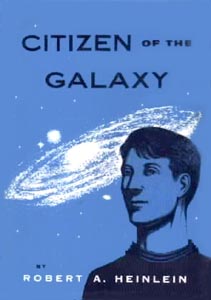
Heinlein's "Citizen of the Galaxy"

Heinlein’s “Citizen of the Galaxy”

Reason has a good think piece by Amy Sturgis on the political content of popular YA (Young Adult) dystopias, compared with the “sensawunda” (sense of wonder) of Golden Age science fiction with its technological optimism. “Not Your Parents’ Dystopias”:

Anyone who has wandered by a bookstore or a movie theater lately knows the kids these days love a nice dystopia. Their heroes are Katniss from Suzanne Collins’ Hunger Games trilogy, Tris from Veronica Roth’s Divergent series, Thomas from James Dashner’s Maze Runner novels. The number of English-language dystopian novels published from 2000 to 2009 quadrupled that of the previous decade, and not quite four years into the 2010s, we have already left that decade’s record in the dust….

Youth-oriented fiction about worlds gone awry is not new. The tradition stretches back generations and involves works now revered as classics. Some of the giants of what was then called juvenile science fiction — Robert Heinlein, Andre Norton, Poul Anderson — wrote what now would be classified as YA dystopias. But the exponential recent growth of the genre suggests something else at play: a generation’s lost wonder and mounting anxiety.

In the Golden Age of science fiction (which may be measured roughly from the time John W. Campbell Jr. came into his full powers as editor of Astounding Stories in 1938 until the time Michael Moorcock’s editorship of New Worlds in 1964 signaled the rise of the New Wave), worlds gone wrong often served as catalysts for young protagonists to pluck up their courage, exercise their agency, and affect change. The titular character in Heinlein’s Starman Jones (1953), Max Jones, inherits a bleak Earth depleted of natural resources. Hereditary guilds have the planet in a stranglehold, regulating information and determining what (if any) profession an individual may pursue. Young Max’s options are few, and his dream of being an “astrogator” in space seems completely out of reach. The risk-taking, indefatigable character pursues his goal anyway, ultimately finding himself in the right place and time to showcase his hard-won skill and — just as important — moral integrity.

Max’s scientific expertise and common sense save lives and win the day. When he finally confesses to lying his way past the rules that would have excluded him from gaining the position at which he excels, that only serves to illustrate how wrong-minded the laws are. The novel ends with Jones not only secure in his chosen calling but paving the way for changes to the oppressive guild system.

These early dystopias showed young men, and sometimes even young women, facing down dangers in their fallen worlds with determination and commitment. The novels suggested that the forward march of freedom and science may meet grave obstacles and even grind to a halt, but if young people rise to the occasion, the story doesn’t have to end there.

Heinlein gave his characters agency — that is, they were able to meaningfully effect outcomes not only for themselves, but for their larger society. Individual effort, knowledge, and pluck, usually with the help of wise older mentors, could triumph over injustice and restrictions on freedom. The Heinlein juveniles, written in simplified style and beginning with relatively unimaginative plots, became increasingly sophisticated until his publisher rejected Starship Troopers for outgrowing the intended youthful audience. The typical protagonist of a Heinlein juvenile is a bright but inexperienced young man from a disadvantaged background who has to learn the ropes and use his wits to make his way into a leadership role in his society–and his female characters also were portrayed as intelligent and strong, often helping the protagonist at a key point with superior knowledge of the social system. It’s interesting that Social Justice Warriors, in their attack on Heinlein and all Golden Age science fiction as essentially patriarchal and in need of political guidance, fail to notice how progressive Heinlein actually was for his era (the 1950s and 60s.) The juveniles are still empowering for both boys and girls, and a protagonist like Podkayne in Podkayne of Mars is a modern empowered girl, with some stereotypically feminine aspects but fully capable of agency in tough situations.

Those Golden Age dystopian visions were balanced by another subgenre of juvenile science fiction popular at the time: tales that portrayed the future as exciting new territory full of marvels and possibilities. Contemporary scholars classify these books as “sensawunda” works, because they conveyed a sense of wonder in contemplating tomorrow.

The poster child for this phenomenon is Tom Swift, the hero of more than 100 novels across five fiction series. In the 1950s, while Heinlein’s Max Jones was fighting for his life and struggling for his livelihood, young Tom was inventing new technologies in his basement (our modern word Taser is an acronym for “Tom A. Swift’s Electric Rifle”), journeying underwater and into space, thwarting baddies of all descriptions, and illustrating just how cool the future would be.

Tom Swift had a triphibian atomicar. Where have all the triphibian atomicars gone now? The millennials, it seems, don’t want a ride….

I’m not sure it is the lack of interest of millennials in technological optimism that has lead to this drought in technology-positive YA science fiction. It may be that very little is getting published because boy’s dreams of agency — the powerful dream of being effective and admired for skill and courage — are no longer seen as important by publishing gatekeepers, now mostly coming out of non-scientific academic literature backgrounds. The videogame industry is now the primary source of young male empowerment fantasies, and it, too, is under siege from the Social Justice Warriors who want its themes to support their political vision of social justice, meaning all visions of the future must be screened for heretical thought — note this month’s war over game politics and SJW influence: “The Gaming Community is not a Wretched Hive of Sexism and Misogyny.” I have personally had my book downgraded by a literary establishment sort for incorrect thoughts — my chapter on entitled Fairy Tale thinking (and the many young women who were brought up with unrealistic expectations of being Princesses catered to by fawning males) was flagged as misogynistic.

The legacy publishing industry has been hiring bright young grads from the academy for some time, and critical mass has been achieved: political screening is now a reality. That is why depressing and unimaginative tales with little commercial appeal (like Pills and Starships) get promoted and plugged on NPR and in the Washington Post and go on to fizzle, while optimistic and empowering science fiction is mostly being self-published. This is because few in publishing now have any education or respect for the sciences and technology:

Another difference between yesteryear’s dystopias and today’s: The older authors were usually either trained in the sciences (Heinlein was a naval engineer; Anderson earned a B.A. in physics) or sympathetic to them (Norton, a librarian, conducted her own research). Like the pioneering author/editor Hugo Gernsback, they believed that quality futuristic fiction could seduce readers into a love affair with science and show them the possibilities it held for a better tomorrow. Thus Anderson’s teenage hero Carl, in Vault of the Ages (1952), ends a future dark ages by unearthing and reintroducing advanced technology to the world. Progress and science walk hand in hand, these authors implied, and no one is in a better position to appreciate this fact than young people.

Today, science is often portrayed as the problem rather than the solution. Many current authors, children’s literature scholar Noga Applebaum notes in her outstanding 2009 study “Representations of Technology in Science Fiction for Young People,” are neither trained in nor sympathetic to the sciences. In fact, a majority of the many novels she analyzes vilify the over-polluted, over-complicated, and over-indulgent present while glorifying the past and the pastoral, a kind of mythical pre-industrial, pre-commercial, subsistence existence — in short, the kind of dark ages that Poul Anderson’s teen hero Carl brought to a welcome end in Vault of the Ages.

As active participants in the contemporary world, young readers are dished a heaping plate of guilt and self-loathing. Why is there global warming, or worldwide poverty, or runaway disease? The answer is as close as the millennials’ smartphones and tablets and gaming systems: Youth and innovation and modernity are to blame.

David Patneade’s Epitaph Road (2010) throws in everything but the kitchen sink when describing the sheer trial of being alive in the oh-so-terrible year of 2010: it was a “world of poverty and hunger and crime and disease and greed and dishonesty and prejudice and war and genocide and religious bigotry and runaway population growth and abuse of the environment and immigration strife and you-get-the-leftovers educational policies and a hundred other horrors.”

Saci Lloyd goes a step further in her award-winning The Carbon Diaries: 2015 (2008). Teen heroine Laura apparently is part of the problem by pursuing a music career with her band, gaining a following online, and benefitting from how easy it is to record and distribute music digitally. She only becomes part of the solution after abandoning her music to become a commune-dwelling, pig-raising, socially conscious activist-though not before performing the novel’s anthem, “Death to Capitalism….”

Are these works the literary equivalent of yelling at those darned kids to get off your lawn, oldsters scolding the youngsters for their perceived failings? Applebaum thinks so, arguing that the trend toward technophobia exposes “adults’ reluctance to embrace the changing face of childhood and the shift in the power dynamic which accompanies this change.” Viewed through its attitudes about technology, she writes, “literature aimed at young people is exposed afresh as problematic, a socialization agent serving adults’ agenda.” Certain adults’ agenda, to be sure.

The biggest exceptions to these trends can be found in the Hunger Games trilogy (2008-2010), which celebrates self-reliance, individual choice, and markets (like The Hob), while warning readers against those who gravitate toward power. (Suzanne Collins also masterfully answers the classic question “Who was right, Aldous Huxley or George Orwell?” by agreeing with both.) But although the Hunger Games novels and their film adaptations are an undeniable sensation, they also represent something of an outlier in terms of theme.

Another exception — or partial exception — is the work of Cory Doctorow. Doctorow’s novels depict technology as the natural ally of youth. The millennials are at a tremendous advantage in the 21st-century landscape, he proposes, because unlike their elders they grew up with a high degree of comfort with both technology and its continual state of change. But even Doctorow’s novels tell a sobering story about the present.

Whether it’s the hackers of Little Brother (2008) and Homeland (2013) or the fan filmmakers of Pirate Cinema (2012), Doctorow’s teen protagonists are routinely forced to defend themselves from older interests who are supported by the government simply because they are more powerful and entrenched in the system. The mighty surveillance state will not disappear, readers realize time and again; the most that kids can hope for is to watch the watchers and let them know that the scrutiny goes both ways. Readers cheer on the gutsy young heroes fighting for their liberty, but we also mourn all the time and effort and creative energy they lose in the struggle simply to stay free and see another day. Their best-case scenario is to fight the powers-that-be to a stalemate.

Amy’s piece continues with more examples.

More on the politics of YA dystopias:

Real-Life “Hunger Games”: Soft Oppression Destroys the Poor
“Pills and Starships” – Pseudo Science Fiction
“Mockingjay” Propaganda Posters

Modern Feminism, Social Justice Warriors, and the American Ideal of Freedom

More on the legacy publishing-indie battle:

Hugh Howey and JAKonrath on the Indie Revolution, and Amazon’s Netflix-for-Books

More on Writers, Novels, Amazon-Hachette

Hugh Howey and JAKonrath on the Indie Revolution, and Amazon’s Netflix-for-Books

Indie Reader Approved

Indie Reader Approved

Hugh Howey’s Wool Series is some of the best indie fiction so far, and it’s been optioned for a movie and published by legacy publishers — but only after he made it a success on his own, through Amazon. J A Konrath was a successful fiction writer with legacy publishers, but has done much better by going indie in recent years, and he acribes much of the support for legacy publishers to a variant of Stockholm Syndrome. His epic post on publishing and a “declaration of Independence” for authors is here:

When in the Course of publishing events, it becomes necessary for writers to sever their ties with the industry that is supposed to have “nurtured” them, a decent respect to the opinions of mankind requires that we should declare the causes which impel those writers to the separation.

We hold these truths to be self-evident, that all writers should have an equal chance to find readers. That their successes or failures should be dependent upon their own actions and their own choices. That they should be paid fairly for their work. That they should have control over the works they produce. That they should have immediate and accurate access to their sales data. That they should be paid promptly. That they should not be restricted from reaching those who may enjoy their work. That whenever a publisher or retailer becomes destructive of these ends, it is the Right of Authors to abolish all connections with the offending parties.

The history of the legacy publishing industry is a history of repeated injuries and usurpations, all having in direct object the establishment of an absolute Tyranny over writers. To prove this, let Facts be submitted to a candid world.

They have given us take-it-or-leave-it, one-sided, unconscionable contracts.
They have failed to adequately market works they have acquired.
They have artificially inflated the price of ebooks.
They have refused to negotiate better ebook royalties for authors.
They have forced unnecessary editing changes on authors.
They have forced unnecessary title changes on authors.
They have forced crappy covers on authors.
They have refused to exploit rights they own.
They have refused to return rights they aren’t properly exploiting.
They take far too long to bring acquired works to market.
They take far too long to pay writers advances and royalties.
Their royalty statements are opaque, out-of-date, and inaccurate.
They orphan authors.
They orphan books.
They refuse to treat authors as equals, let alone with a reasonable measure of fairness.
They make mistakes and take no responsibility for those mistakes.
For every hope they nurture, they unnecessarily neglect and destroy countless others.
They have made accessories of the authors’ ostensible representative organization, the quisling Authors Guild, and are served, too, by the misleadingly named Association of Authors’ Representatives.
They have failed to honor promises made.
They have failed to honor their own onerous contract terms.
They’ve failed the vast majority of authors, period.

This blog has documented nearly every stage of these Oppressions, and in many cases offered solutions to publishers, and has been answered with only silence and derision.

But that’s okay. Because now authors have a choice.

We shall never be taken advantage of again. We shall not support any publisher or retailer that continues the abuses listed above. And we demand to share in the rewards we’ve busted our asses for.

In other news, the subscription reading service a la Netflix is popping up everywhere: Scribd and Oyster have already been active, and Amazon is in test phases. For c. $10 a month you can read umlimited numbers of works from their catalog, a good deal for avid readers, and catalogs are growing more extensive. Amazon’s new service is most fully described by GigaOm:

So far, the differences appear to be that Kindle Unlimited has no Big Five titles and Kindle Unlimited includes audiobooks. One major difference is that Kindle Unlimited will likely be available through Kindle e-readers. That’s not true for Scribd or Oyster. And it would be a big reason for avid Kindle e-reader users to choose Kindle Unlimited rather than Scribd or Oyster: If they are already using their e-reader all the time anyway, and can now access more books through it via a subscription, that would be a big perk.

How do authors get paid?

It depends on who your publisher is. Publishers Lunch reported Wednesday (subscription required) that publishers participating “via direct agreement” — which appear to be Houghton Mifflin Harcourt, Bloomsbury, Open Road and Workman, among others — will be paid an ebook’s wholesale price when a reader completes a certain percentage of the book. That’s the same way that Scribd and Oyster operate. Then there are those well-known “big” books also included in the Kindle Owners’ Lending Library, like the Harry Potter series and the Hunger Games trilogy: Amazon has a separate Harry Potter deal that presumably encompasses (or was changed to expand to) Kindle Unlimited as well, while in the case of the Hunger Games, according to PL, “Scholastic will get paid their full wholesale price every time one of their ebooks is opened by a Kindle Unlimited subscriber.”

If you’re a self-published author participating in KDP Select, however, it looks as if your book can be included without your explicit permission simply under the terms and conditions you already agreed to: According to one poster on the Kindle Boards, “Books in Select will automatically be enrolled. Like the KOLL you won’t be able to opt-out if you’re in Select. You will be payed [sic] if you someone reads 10% or more of your book. The payment will come out of the same KOLL fund, just as if it was a borrow.” That “same KOLL fund” is a set pool of money from which self-published authors are paid each time their book is borrowed. Its amount changes every month but in July the total fund was $1.2 million.

More on Writers, Novels, Amazon-Hachette

Amazon Hachette

Amazon Hachette

I wrote earlier about the underlying issues in the Amazon vs. Hachette dispute.

The New York Times has a good story by David Streitfeld on one author who has done well with Amazon’s relatively new publishing arm:

Vincent Zandri hails from the future. He is a novelist from the day after tomorrow, when Amazon has remade the worlds of writing, printing, selling and reading books so thoroughly that there is hardly anything left besides Amazon.

Mr. Zandri, an author of mystery and suspense tales, is published by Thomas & Mercer, one of Amazon Publishing’s many book imprints. He is edited by Amazon editors and promoted by Amazon publicists to Amazon customers, nearly all of whom read his books in electronic form on Amazon’s e-readers, Amazon’s tablets and, soon, Amazon’s phones.

His novels are not sold in bookstores, and rarely found in public libraries. His reviews are written by Amazon readers on the Amazon website. “Has a little bit of something for everyone,” one enthusiast exclaimed. “Heavy machinery, love, humor and mystery.” And his latest prize was an award from Amazon.

A few years ago he was reduced to returning bottles and cans for grocery money. Now his Amazon earnings pay for lengthy stays in Italy and Paris, as well as expeditions to the real Amazon. “I go wherever I want, do whatever I want and live however I want,” he said recently at a bar in Mill Valley, Calif., a San Francisco suburb where he was relaxing after a jaunt to Nepal.

Mr. Zandri, who 15 years ago had a $235,000 contract with a big New York house that went sour, has an answer.

“Everything Amazon has promised me, it has fulfilled — and more,” he said. “They ask: ‘Are you happy, Vince? We just want to see you writing books.’ That’s the major difference between corporate-driven Big Five publishers, where the writer is not the most important ingredient in the soup, and Amazon Publishing, which places its writers on a pedestal.”

Amazon believes that publishers take too much of the money in producing a book and add too little value. In traditional publishing, the highest royalty a writer could get was 15 percent of the book’s price. With e-books, the royalty is 25 percent of net revenue, but Amazon feels that is still not enough. Mr. Zandri gets 35 percent, and self-published writers who use Amazon’s platform get more.

In interviews, for the first time, executives from Amazon and Hachette explicitly described their positions.

“If you charge high e-book prices, ultimately what you’re doing is making a slow, painful slide to irrelevancy,” said Russell Grandinetti, Amazon’s senior vice president for Kindle. “You have to draw the box big. Books don’t just compete against books. Books compete against Candy Crush, Twitter, Facebook, streaming movies, newspapers you can read for free. It’s a new world. It’s so important not to simply build a moat around the industry the way it is now.”

Amazon favors a price of $9.99 for many e-book titles, while Hachette and other publishers want to charge more. Sixty percent of Hachette’s e-book sales in the United States occur on Amazon.

“For most books, $9.99 creates more total revenue than $14.99,” Mr. Grandinetti said. “That means $9.99 creates more total dollars to share with authors.”

From the point of view of legacy publishers, they have bought their oligopoly fair and square, and anything they can do to slow change which threatens to take control away from them is good. The 4-5 big publishing conglomerates control most print sales and distribution, which for blockbusters is still wildly profitable, and the complex legacy system with its agents, publishers, distributors, and bookstores is being eroded by lower-cost ebooks and authors-as-publishers. So while they lose some revenue by overpricing ebooks and stiff the authors of royalties, they delay the transition to the much lower cost structure of ebooks.

The gatekeeping function of legacy publishers will have to arise in some sort of online reviewing and quality screening function. Amazon reviews are now used for this for both Amazon and other sites (which don’t do enough volume to have any depth of reviews except for the biggest-selling books.) Amazon recently purchased Goodreads, which was an attempt at an independent user review site, so it still controls most online customer reviews.

Also amusing: The Many Good Reasons Not to Write a Novel.

Another good read: Mad Genius Club on declining author income vs. publisher profits.

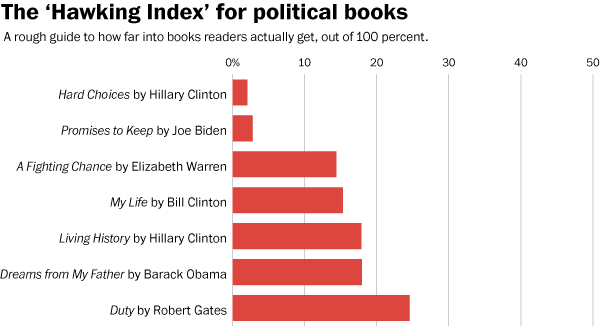
The Hawking Index of Unread Blockbusters

Hawking Index of recent Political Bestsellers

Hawking Index of recent Political Bestsellers

Until now we only had anecdotal evidence that many “blockbuster” books pushed by media and reviewers went largely unread (the most famous past example was Gravity’s Rainbow, critically acclaimed literature that was so dense and bereft of compelling narrative that few purchasers actually finished it.)

But now we have the “Hawking Index,” named after Stephen Hawking for his Brief History of Time, also hugely recommended and rarely finished. While we have no way of knowing how many Major Books purchased in hardcover at bookstores end up as doorstops, we now have data from Amazon Kindle books, which make available on their Amazon pages the location and number of notations users make within the book; it turns out many books have notations near the beginning but few or none near the end, indicating users did not make it that far. Since many books do have notations to the end, we know it’s not just because readers get tired of annotating; they simply stop reading.

WaPo has a good story on this, adding Hillary Clinton’s latest as another much-purchased, rarely-finished book, to go along with Thomas Piketty’s Capital in the Twenty-First Century as a best-selling bust with readers:

The summer’s most-read book? Donna Tartt’s “The Goldfinch.” Least-read? Thomas Piketty’s “Capital in the Twenty-First Century,” for which the notations only get about 2.4 percent of the way in.

So, naturally, we decided to apply this methodology to “Hard Choices” and other recent or comparable political books. And we have our own ranking, which we now present in order from estimated-least- to estimated-most-read.

1. “Hard Choices,” by Hillary Clinton. Hawking Index: 2.04 percent. Well, there you have it. The deepest into Hard Choices the popular highlights get is page 33, a quote about smart power. Three of the five most-popular highlights occur within the first 10 pages. We will note the same caveat that Ellenberg applies to Piketty. “Hard Choices” is fairly new, and fairly long. Still, though, one would think more people had made it past page 33.

The most popular quote? “Do all the good you can, at all the times you can, to all the people you can, as long as ever you can.” Which, like several of the top quotes from the authors listed below, isn’t actually a quote from Hillary Clinton. Instead, it’s a mantra from her family’s Methodist faith.

I took a look at my own book and the highlights readers chose seem to indicate most readers read it all the way through — the two most popular:

Most of the trouble in relationships is about bad signaling and poor responses. (6 Highlighters)

A good partner is reliable and available to help on call, whenever possible; a good partner leaves his partner alone when help is not needed, staying quietly available behind the scenes…. (5 Highlighters)

…which I actually wrote, though some of the prettiest language highlighted by users is quoted from other books (where a thought was expressed so beautifully I could not improve upon it.)

“Pills and Starships” by Lydia Millet – Pseudo Science Fiction

Pills and Starships by Lydia Millet

Pills and Starships by Lydia Millet

As a reader of science fiction from age 6 (if Tom Swift books qualify, which they do), it pains me to see politicized and depressing stories for young people, promoted by a certain negative East Coast US mindset that believes technology and the future are bad things, that freedom of thought is dangerous, and that Progress is about appointing certain right-thinking types (the nomenklatura that are literate in the arts but not in the sciences) to direct everyone down the righteous path to equality and Utopia.

I also have a background in literary fiction: I have, for example, met John Updike at a Harvard writing class where he was a special guest, and experienced the joy of rejection slips with encouraging notes from the New Yorker. The New York/East Coast literary establishment — the academics, the publishers in Manhattan, the magazines that dictated tastes and high culture like the New Yorker — are in steep decline these days, and the damnable public insists on reading much more genre fiction, finding the literary novel less accessible and entertaining. Nothing makes a high-literary sort burn with resentment more than seeing self-published trash like 50 Shades of Gray and good science fiction like the Wool series route around the tasteful gatekeepers to make $millions for their authors.

Thus there is a temptation for literary authors whose sales are flagging to try to write in genres that might sell better. Unfortunately they sometimes try science fiction (which, if it is less technological but still projects a future society that runs on different principles, is sometimes called “speculative fiction.”) Being a futurist or technologist, or both, is not something most literary authors have the background for, and their lack of interest shows when they try it — generally they pick up the most hackneyed, uncreative current memes about the future and project them, mixed with their political biases, into a future world or society that is implausible to any student of technology or history.

A fine early example of this was Margaret Atwood’s The Handmaid’s Tale, which could only have been written by someone ignorant of the true American character. Somehow a people who are cantankerous and barely able to tolerate gun regulation are going to acquiesce to a fundamentalist religious dictatorship that enslaves women — really? Only an academic author would believe something so preposterous. The Wikipedia entry on the novel sets the scene:

Beginning with a staged terrorist attack (blamed on Islamic extremist terrorists) that kills the President and most of Congress, a movement calling itself the “Sons of Jacob” launches a revolution and suspends the United States Constitution under the pretext of restoring order. They are quickly able to take away all of women’s rights, largely attributed to financial records being stored electronically and labelled by gender. The new regime moves quickly to consolidate its power and reorganize society along a new militarized, hierarchical, compulsorily Christian regime of Old Testament-inspired social and religious ultra-conservatism among its newly created social classes. In this society, almost all women are forbidden to read.

This book became a bestseller and a movie, and the East Coast literati (with their paranoia about the feared Other, the fundamentalist religionists who were then getting headlines) were completely willing to believe that only one or two elections separated the US from a totalitarian religious state.

I was listening to NPR yesterday and heard an interview with author Lydia Millet about her new book, Pills and Starships. The book sounded like similar literati scare-mongering by someone of little or no scientific background, so I investigated further.

The PR blitzes legacy publishers can provide for a new book are still amazing. Not only is she getting a PR plug by those influence-peddlers at NPR for her crappy book, there are reviews in the Washington Post and the New York Journal of Books, as well as dozens of planted reviews at Goodreads. The book has climbed to around #2,000 on Amazon’s bestselling list but has only two reviews there so far, meaning the publisher was not able to game Amazon’s review system as effectively.

The world she proposes for the future (from the Amazon page):

Earth reached its ecological tipping point some years ago, and corporations now manage all aspects of life. No more babies are being born, the elderly must purchase contracts to die, and drugs (“pharma”) control a dwindling human population. Natalie’s parents have purchased a death contract, and they have one final week together. The 17-year-old must keep a journal, which she addresses to an unknown space traveler—the only place where starships come into the story. As the Bountiful Passing approaches, Nat and her rebellious younger brother, Sam, begin to make plans to save their parents, or, at the very least, to rescue themselves from the tyranny of the corps and their Death Math. A predictable plot and strained teen voice distract from the very beginning and with 90-plus pages of backstory, the real action doesn’t begin until well into the book. The ecological theme, clearly a passion of the author, unfortunately comes across as too heavy-handed and didactic in tone. An additional purchase only.—Katherine Koenig, The Ellis School, PA

Here’s her author bio from Amazon:

Lydia Millet is a novelist and short-story writer known for her dark humor, idiosyncratic characters and language, and strong interest in the relationship between humans and other animals. Born in Boston, she grew up in Toronto and now lives outside Tucson, Arizona with her two children, where she writes and works in wildlife conservation. Sometimes called a “novelist of ideas,” Millet won the PEN-USA award for fiction for her early novel My Happy Life (2002); in 2010, her story collection Love in Infant Monkeys was a finalist for the Pulitzer Prize. In 2008, 2011, and 2012 she published three novels in a critically acclaimed series about extinction and personal loss: How the Dead Dream, Ghost Lights, and Magnificence. June 2014 will see the publication of her first book for young-adult readers, Pills and Starships — an apocalyptic tale of death contracts and climate change set in the ruins of Hawaii.

She has no background in economics, history, or hard sciences, but with “feelings” and a literary sensibility, she is willing to project a stunningly unimaginative future designed to reinforce current public school emphasis on “climate change” and the depressing fate that awaits us all if we don’t follow “feelings” as a guide to policy. The widespread promotion of this kind of propaganda to young people might have been useful when the education establishment drenched them in optimistic technocratic futures, but now it is just piling on a Conventional Wisdom that discourages any kind of planning for a brighter future. A subversive work now would be technologically optimistic and recognize how much better the future will be than the past for most people.

There’s a place for dystopias in Young Adult fiction, for example the Hunger Games series. But they should be sharp and imaginative and realistic about how real people respond to conditions.

Here are some fragments from reviews less influenced by PR quid pro quos:

I didn’t love this book. The book is told as a journal, with the audience some unknown spacefarer on a ship somewhere out in the solar system. And for me, that’s where it doesn’t work. Okay, I understand the point of a journal, but I think Millet sticks a little too strictly to the format, telling us far more than she shows us. If anything, the beginning drags as she explains and explains the world where Nat and Sam live.

I did care about the characters, but it would have been more enjoyable for me to see things as they unfolded. Millet even describes the dialog in places, rather than recounting it — or trying to recount it — which comes across as a rookie mistake. Just when the plot was getting good, the book ended, too, which left me feeling like I’d missed something. — Dean Fetzer at LitReactor.com

… When, from beneath the glossy surface, a disturbing reality begins to emerge, Nat’s emotionally flat narration makes it hard to care. Passive and without affect, she accepts her parents’ choices and later abandons her brother during a horrendous storm with elegiac regret. Despite exposition that’s rarely interrupted by dialogue, this world’s puzzlingly out of focus, real places carelessly portrayed. The novel’s narrative conceit has Nat explaining her story to a hypothetical distant reader. Summarizing the action robs it of suspense and interest: Readers do not see the story unfold and watch characters act and interact, making it difficult for them to interpret their behavior for themselves.

Detail may be the lifeblood of fiction, but storytelling is its pumping heart; without it, this all-premise effort is DOA. — Kirkus Reviews

In other words, it’s bad fiction as well as bad science fiction. Yet it will be sold and pumped up by the ideologically-biased publishing industry, which is doing a fine job of destroying itself by promoting the dull and correct while blocking the novel and subversive works of much better authors.

For an update on this topic and the ongoing war in gaming see: YA Dystopias vs Heinlein et al: Social Justice Warriors Strike Again

For more on pop culture:

The Lessons of Walter White
“Blue Valentine”
“Mad Men”
The Morality of Glamour
“Mockingjay” Propaganda Posters
“Big Bang Theory” — Aspergers and Emotional/Social Intelligence
Real-Life “Hunger Games”: Soft Oppression Destroys the Poor
Reading “50 Shades of Grey” Gives You Anorexia and an Abusive Partner!
YA Dystopias vs Heinlein et al: Social Justice Warriors Strike Again
“Raising Arizona” — Dream of a Family

Amazon vs. Hachette: Future of Publishing

amazonhachette
You may have heard of the ongoing contract struggle between Amazon and Hachette, one of the big four publishers left after a decade of consolidation in the industry. Amazon has been a big factor in disrupting the business of getting books to readers, after the previous decade saw big-box booksellers undercutting and eliminating a lot of independent bookstores. While I know many people are nostalgic for the small bookstore experience — browsing, serendipitous discovery, personal recommendations — the digitization of books was bound to make that a niche experience. Like most people over thirty, I grew up reading books from the library and the few bookstores in my area; this limited what I could read to what had passed a series of gatekeepers, so while the selection was good in quality it was also homogenized to reach larger audiences and limited in amount.

With ebooks you will see a variety of changes as the written word is freed from some of the strictures of conventional publishing. For example, the economies of scale of paperback marketing, printing and shipping meant there was little profit to be made from short books, so the standard size of a paperback novel rose from 200-300 pages to 400-600 pages, as publishers pressured authors to write longer to increase profit margins. With ebooks, there is much less friction for smaller works, so novels will tend to be less padded and epics less dominant. Amazon has even introduced Kindle Singles, novellas or even short stories and short nonfiction at their natural length and priced appropriately. The legacy publishing industry had abandoned these forms, with only magazines left to print them and in increasingly limited quantities and lower payments for authors. So many established authors are unearthing earlier work considered “uncommercial” and releasing it in this form, which benefits everyone.

Legacy publishers provided valuable services in filtering, editing, and marketing author’s work, but in recent years had focused on bestsellers as the economics of publishing what is called “midlist” (steady but small sellers, of less mass-market interest) discouraged them. This was in part due to big box book retailing; when Costco and Target sell more printed books than all but the largest chain, discounted commodity books win, all others lose.

In reaction, publishers are learning to work with successful self-published authors who created their own markets and fan bases. The two most famous examples are the 50 Shades of Grey series and the Wool novels, both cultivated by the authors through online marketing to sales high enough to prove their value to mass-market publishers. Signing with legacy publishers gave these authors more distribution and marketing muscle to reach the half of the population that still only sees books in stores.

Publishers, editors, marketers, and agents are also unbundling services to allow very small and self-publishers access to a la carte services as needed. There’s now a thriving online market in proofreading, editing, layout, cover design, marketing, PR, and negotiation. The sort of homogenized, focus-group-driven blockbusters legacy publishers had focused on will continue to be produced, but there is now a path for long-tail books (which speak to tiny audiences and must therefore have lower costs) to be produced in large numbers. Authors who are read will make as much money as they did from the publishers, and have a freer hand to execute their visions. Of course this also means there will be a lot of hopeful but dreadful authors self-publishing, so the old gatekeeping function of publishing will have to come from independent reviews and word-of-mouth from readers, which means it will take much longer for a new book to become known.

This post was motivated by a post on the Smashwords blog. Smashwords is an ebook distribution platform competing with Amazon, so their view of Amazon as predatory is partly self-interested, but it is a nice discussion of the issues. It is certainly possible Amazon increased author royalties on ebooks to get authors away from publishers, then may squeeze royalities later as their market power increases, but the existence of many alternative platforms like Smashwords should keep that in check. Amazon’s advantages in search and user reviews is very large, though, and it’s clear that if they wanted to they could squeeze authors — but so far they have not.