Books

Malignant Narcissists

The Charming Narcissist

The Charming Narcissist

There are few encounters more damaging than those you have with extreme narcissists — in romance or as managers they often end up trying to control you through abuse. Here’s part of the chapter on narcissists from Bad Boyfriends: Using Attachment Theory to Avoid Mr. (or Ms.) Wrong and Make You a Better Partner:

Extreme versions of the attachment types can be diagnosed in adults as disorders. Many theorists believe that an entrenched avoidant attachment is at the core of the narcissistic personality disorder.[1]

Narcissism to varying degrees is a normal personality trait—we could substitute “self-centered” for the term and be correct. Psychologists think youthful narcissism is a part of typical emotional development—the stage where you say “Mine!” when asked about any toy. Normal children grow out of this as they experience the evaluations of others, and create a more realistic view of themselves and others as they grow up.

Many high-achieving adults score high on a narcissism test, being preoccupied with how they look to the world and working hard to increase the admiration received from others. In many professions this can be a useful and even necessary trait. But the most effective of them also understand and value the feelings of others, and thus are more successfully manipulative in getting them to do their bidding.

When we talk about dysfunctional narcissism, we are talking about adults whose self-centeredness and use of others to satisfy a deep need to be the center of attention has gone beyond functional to become abusive. The harm they do to their partners comes from manipulation, verbal and physical abuse, and abandonment—because the attention of a partner is only valued when it is shiny and new, and the increasing distress of a narcissist’s partner is met with hostility instead of efforts to reassure. The narcissist has little empathy or sympathy for the feelings of others since he or she is only concerned about getting the attention needed to cover up the hollowness of their low self-esteem.

How does the narcissist get that way? As a defense to caregiving that devalues the child’s true self, often provided by a narcissistic caregiver who needs the child to be “perfect” and “special” because that is how the caregiver views herself.

Babies crave having their performance validated, they need to be seen and loved for who they truly are, and they need to be given an ongoing sense of belonging, of being a valued fellow being in the family. If a mother fails consistently to attune to her baby in this way and to respond to his complex emotional needs, the young child, feeling unknown and unappreciated, is unable to know or appreciate himself. He shrinks back into a sense of helplessness, smallness, defectiveness, and shame, which he may then defend against by clinging to his infantile grandiosity, a grandiosity one or both of his parents may promote.… Outwardly self-important, prone to pomposity, self-adoration, and an annoying attitude of entitlement, he is haunted by a fragile self-esteem. His friends complain he’s only interested in talking about himself, his boss that he takes frustrations too personally, his neighbors that he’s pushy and conceited.[2]

Narcissistic personalty disorder is a recognized diagnostic category defined by the DSM-IV-TR, with these symptoms:

• Expects to be recognized as superior and special, without superior accomplishments
• Expects constant attention, admiration, and positive reinforcement from others
• Envies others and believes others envy him/her
• Preoccupied with thoughts of great success, enormous attractiveness, power, intelligence
• Lacks the ability to empathize with the feelings or desires of others
• Is arrogant in attitudes and behavior
• Has expectations of special treatment that are unrealistic

Splitting is the defense mechanism narcissists use to save their fragile self-images from real-world negative evaluation. The self is grandiosely inflated and all which fails to reflect this false high self-esteem is devalued, “splitting” the world into good self-and-adherents and bad everything else. “Other people are either manipulated as an extension of one’s own self, who serve the sole role of giving admiration and approval, or they are seen as worthless (because they cannot collude with the narcissist’s grandiosity).”[3]

Narcissists are users: they exploit others ruthlessly for their own needs, and as a result tend to have few or no long-term relationships, with shallow and utilitarian relationships predominant.

Because of their underlying lack of self-esteem and dependence on others, they are deeply hurt or angered by criticism or a lack of the attention they feel they deserve, imagining slights in the most minor incidents.[4] Not having a realistic understanding of the emotional states of others, constant reinforcement of their egos (called narcissistic supply) is required for them to remain stable. If a relationship partner is critical or fails to provide the needed supply of ego-boosting attention, the narcissist will go into a rage and devalue the partner, with physical or emotional abuse being a common control technique. Tearing down others makes the narcissist feel better about themselves, and one key to recognizing a narcissist quickly is a self-reported history of being involved almost entirely with unreliable, crazy, or otherwise defective partners. No relationship breakdown is ever the narcissist’s fault!

Narcissists believe they are special and better than other people, and if the universe fails to confirm their belief as it becomes clear in later life that their grandiose expectations will remain unsatisfied, psychic collapse and depression can result. Narcissists rarely recognize any problem with their condition until depression and loss have made them desperate.

How to Recognize a Narcissist

A narcissist tends to talk about himself in glowing terms and denigrate or diminish others in his life; if your date mentions several previous partners and has something bad to say about all of them, he’s probably a narcissist, because no relationship issue is ever his fault. Putting down others to feel superior is their thing.

The narcissist may have the outward trappings of success, but of all the types in this book, the narcissist is the most likely to be deeply in debt to keep up appearances. The car is leased, the teeth are capped, the successes they talk about are exaggerations. If no one you’ve met knows him well and you can’t confirm his stories, beware.

In conversation, if he seems unwilling to listen to you talking about your life and your feelings, beware. No matter how interesting he seems to be, if he doesn’t show signs of caring about how you feel, don’t get sucked in. Ask yourself why this person wants you around if they don’t care to know your history, your feelings, your friends, and your family—is it because you make a great fashion accessory? Does he look more successful when you’re with him?

Any hint of controlling behavior—extreme jealousy, paranoid accusations, the sense that you have to justify yourself constantly—is a red flag. Also note as signs: overreacting to mild criticism, rages and tantrums when questioned, denial of obvious facts and events you have witnessed, and frequent lies and evasions.

The Abusive Narcissist

The classic abusive partner is a narcissist. Using verbal and physical abuse to control and maintain his relationship with a partner treated as an accessory, a narcissist can spend years demeaning and abusing a partner who is locked into a co-dependence; commonly the partner has fallen into extreme dependence as the narcissist has manipulated his partner into cutting off relationships with friends and family who might help. The narcissist will at first build up a victim and treat the victim well, then devalue and abuse, and this can be cyclic—if about to actually lose their partner, they will pretend to feel remorse and behave more sensitively for just long enough to lull the victim into staying. A long-term relationship with an abusive narcissist can severely damage the victim’s self-esteem, finances, and support network, leaving him or her with few resources to recover.

Be aware that some of the more attractive people you will meet are narcissists, and they are life-destroying in a long-term relationship. Run like hell if you meet one.

Further Reading

Footnotes:

[1] Karen, p. 390
[2] Karen, p. 390
[3] Kernberg, O.F. (1970). “Factors in the psychoanalytic treatment of narcissistic personalities.” Journal of the American Psychoanalytic Association, 18:51–85
[4] Jordan, C. H.; Spencer, S. J.; Zanna, M. P.; Hoshino-Browne, E.; Correll, J. (2003). “Secure and defensive high self-esteem”. Journal of Personality and Social Psychology 85 (5): 969–978. “A person can have a high self-esteem and hold it confidently where they do not need reassurance from others to maintain their positive self view, whereas others with defensive, high self-esteem may still report positive self-evaluations on the Rosenberg Scale, as all high self-esteem individuals do; however, their positive self-views are fragile and vulnerable to criticism. Defensive high self-esteem individuals internalize subconscious self-doubts and insecurities causing them to react very negatively to any criticism they may receive. There is a need for constant positive feedback from others for these individuals to maintain their feelings of self-worth. The necessity of repeated praise can be associated with boastful, arrogant behavior or sometimes even aggressive and hostile feelings toward anyone who questions the individual’s self-worth, an example of threatened egotism.” http://en.wikipedia.org/wiki/Self-esteem

More on Narcissists:

Malignant Narcissists
Teaching Narcissists to Activate Empathy

More on Attachment and Personality Types:

What Attachment Type Are You?
Type: Secure
Type: Anxious-Preoccupied
Type: Dismissive-Avoidant
Type: Fearful-Avoidant (aka Anxious-Avoidant)
Avoidant: Emotions Repressed Beneath Conscious Level
Serial Monogamy: the Fearful-Avoidant Do It Faster
Anxious-Preoccupied: Stuck on the Dismissive?
Anxious-Preoccupied / Dismissive-Avoidant Couples: the Silent Treatment
nxious-Preoccupied: Clingy and Insecure Relationship Example
Domestic Violence: Ray and Janay Rice
Histrionic Personality: Seductive, Dramatic, Theatrical
Life Is Unfair! The Great Chain of Dysfunction Ends With You.
Love Songs of the Secure Attachment Type
On Addiction and the Urge to Rescue
Sale! Sale! Sale! – “Bad Boyfriends” for Kindle, $2.99
Controlling Your Inner Critic: Subpersonalities
“Big Bang Theory” — Aspergers and Emotional/Social Intelligence
Porn Addiction and NoFAP
Introverts in Management

Hugh Howey and JAKonrath on the Indie Revolution, and Amazon’s Netflix-for-Books

Indie Reader Approved

Indie Reader Approved

Hugh Howey’s Wool Series is some of the best indie fiction so far, and it’s been optioned for a movie and published by legacy publishers — but only after he made it a success on his own, through Amazon. J A Konrath was a successful fiction writer with legacy publishers, but has done much better by going indie in recent years, and he acribes much of the support for legacy publishers to a variant of Stockholm Syndrome. His epic post on publishing and a “declaration of Independence” for authors is here:

When in the Course of publishing events, it becomes necessary for writers to sever their ties with the industry that is supposed to have “nurtured” them, a decent respect to the opinions of mankind requires that we should declare the causes which impel those writers to the separation.

We hold these truths to be self-evident, that all writers should have an equal chance to find readers. That their successes or failures should be dependent upon their own actions and their own choices. That they should be paid fairly for their work. That they should have control over the works they produce. That they should have immediate and accurate access to their sales data. That they should be paid promptly. That they should not be restricted from reaching those who may enjoy their work. That whenever a publisher or retailer becomes destructive of these ends, it is the Right of Authors to abolish all connections with the offending parties.

The history of the legacy publishing industry is a history of repeated injuries and usurpations, all having in direct object the establishment of an absolute Tyranny over writers. To prove this, let Facts be submitted to a candid world.

They have given us take-it-or-leave-it, one-sided, unconscionable contracts.
They have failed to adequately market works they have acquired.
They have artificially inflated the price of ebooks.
They have refused to negotiate better ebook royalties for authors.
They have forced unnecessary editing changes on authors.
They have forced unnecessary title changes on authors.
They have forced crappy covers on authors.
They have refused to exploit rights they own.
They have refused to return rights they aren’t properly exploiting.
They take far too long to bring acquired works to market.
They take far too long to pay writers advances and royalties.
Their royalty statements are opaque, out-of-date, and inaccurate.
They orphan authors.
They orphan books.
They refuse to treat authors as equals, let alone with a reasonable measure of fairness.
They make mistakes and take no responsibility for those mistakes.
For every hope they nurture, they unnecessarily neglect and destroy countless others.
They have made accessories of the authors’ ostensible representative organization, the quisling Authors Guild, and are served, too, by the misleadingly named Association of Authors’ Representatives.
They have failed to honor promises made.
They have failed to honor their own onerous contract terms.
They’ve failed the vast majority of authors, period.

This blog has documented nearly every stage of these Oppressions, and in many cases offered solutions to publishers, and has been answered with only silence and derision.

But that’s okay. Because now authors have a choice.

We shall never be taken advantage of again. We shall not support any publisher or retailer that continues the abuses listed above. And we demand to share in the rewards we’ve busted our asses for.

In other news, the subscription reading service a la Netflix is popping up everywhere: Scribd and Oyster have already been active, and Amazon is in test phases. For c. $10 a month you can read umlimited numbers of works from their catalog, a good deal for avid readers, and catalogs are growing more extensive. Amazon’s new service is most fully described by GigaOm:

So far, the differences appear to be that Kindle Unlimited has no Big Five titles and Kindle Unlimited includes audiobooks. One major difference is that Kindle Unlimited will likely be available through Kindle e-readers. That’s not true for Scribd or Oyster. And it would be a big reason for avid Kindle e-reader users to choose Kindle Unlimited rather than Scribd or Oyster: If they are already using their e-reader all the time anyway, and can now access more books through it via a subscription, that would be a big perk.

How do authors get paid?

It depends on who your publisher is. Publishers Lunch reported Wednesday (subscription required) that publishers participating “via direct agreement” — which appear to be Houghton Mifflin Harcourt, Bloomsbury, Open Road and Workman, among others — will be paid an ebook’s wholesale price when a reader completes a certain percentage of the book. That’s the same way that Scribd and Oyster operate. Then there are those well-known “big” books also included in the Kindle Owners’ Lending Library, like the Harry Potter series and the Hunger Games trilogy: Amazon has a separate Harry Potter deal that presumably encompasses (or was changed to expand to) Kindle Unlimited as well, while in the case of the Hunger Games, according to PL, “Scholastic will get paid their full wholesale price every time one of their ebooks is opened by a Kindle Unlimited subscriber.”

If you’re a self-published author participating in KDP Select, however, it looks as if your book can be included without your explicit permission simply under the terms and conditions you already agreed to: According to one poster on the Kindle Boards, “Books in Select will automatically be enrolled. Like the KOLL you won’t be able to opt-out if you’re in Select. You will be payed [sic] if you someone reads 10% or more of your book. The payment will come out of the same KOLL fund, just as if it was a borrow.” That “same KOLL fund” is a set pool of money from which self-published authors are paid each time their book is borrowed. Its amount changes every month but in July the total fund was $1.2 million.

More on Writers, Novels, Amazon-Hachette

Amazon Hachette

Amazon Hachette

I wrote earlier about the underlying issues in the Amazon vs. Hachette dispute.

The New York Times has a good story by David Streitfeld on one author who has done well with Amazon’s relatively new publishing arm:

Vincent Zandri hails from the future. He is a novelist from the day after tomorrow, when Amazon has remade the worlds of writing, printing, selling and reading books so thoroughly that there is hardly anything left besides Amazon.

Mr. Zandri, an author of mystery and suspense tales, is published by Thomas & Mercer, one of Amazon Publishing’s many book imprints. He is edited by Amazon editors and promoted by Amazon publicists to Amazon customers, nearly all of whom read his books in electronic form on Amazon’s e-readers, Amazon’s tablets and, soon, Amazon’s phones.

His novels are not sold in bookstores, and rarely found in public libraries. His reviews are written by Amazon readers on the Amazon website. “Has a little bit of something for everyone,” one enthusiast exclaimed. “Heavy machinery, love, humor and mystery.” And his latest prize was an award from Amazon.

A few years ago he was reduced to returning bottles and cans for grocery money. Now his Amazon earnings pay for lengthy stays in Italy and Paris, as well as expeditions to the real Amazon. “I go wherever I want, do whatever I want and live however I want,” he said recently at a bar in Mill Valley, Calif., a San Francisco suburb where he was relaxing after a jaunt to Nepal.

Mr. Zandri, who 15 years ago had a $235,000 contract with a big New York house that went sour, has an answer.

“Everything Amazon has promised me, it has fulfilled — and more,” he said. “They ask: ‘Are you happy, Vince? We just want to see you writing books.’ That’s the major difference between corporate-driven Big Five publishers, where the writer is not the most important ingredient in the soup, and Amazon Publishing, which places its writers on a pedestal.”

Amazon believes that publishers take too much of the money in producing a book and add too little value. In traditional publishing, the highest royalty a writer could get was 15 percent of the book’s price. With e-books, the royalty is 25 percent of net revenue, but Amazon feels that is still not enough. Mr. Zandri gets 35 percent, and self-published writers who use Amazon’s platform get more.

In interviews, for the first time, executives from Amazon and Hachette explicitly described their positions.

“If you charge high e-book prices, ultimately what you’re doing is making a slow, painful slide to irrelevancy,” said Russell Grandinetti, Amazon’s senior vice president for Kindle. “You have to draw the box big. Books don’t just compete against books. Books compete against Candy Crush, Twitter, Facebook, streaming movies, newspapers you can read for free. It’s a new world. It’s so important not to simply build a moat around the industry the way it is now.”

Amazon favors a price of $9.99 for many e-book titles, while Hachette and other publishers want to charge more. Sixty percent of Hachette’s e-book sales in the United States occur on Amazon.

“For most books, $9.99 creates more total revenue than $14.99,” Mr. Grandinetti said. “That means $9.99 creates more total dollars to share with authors.”

From the point of view of legacy publishers, they have bought their oligopoly fair and square, and anything they can do to slow change which threatens to take control away from them is good. The 4-5 big publishing conglomerates control most print sales and distribution, which for blockbusters is still wildly profitable, and the complex legacy system with its agents, publishers, distributors, and bookstores is being eroded by lower-cost ebooks and authors-as-publishers. So while they lose some revenue by overpricing ebooks and stiff the authors of royalties, they delay the transition to the much lower cost structure of ebooks.

The gatekeeping function of legacy publishers will have to arise in some sort of online reviewing and quality screening function. Amazon reviews are now used for this for both Amazon and other sites (which don’t do enough volume to have any depth of reviews except for the biggest-selling books.) Amazon recently purchased Goodreads, which was an attempt at an independent user review site, so it still controls most online customer reviews.

Also amusing: The Many Good Reasons Not to Write a Novel.

Another good read: Mad Genius Club on declining author income vs. publisher profits.

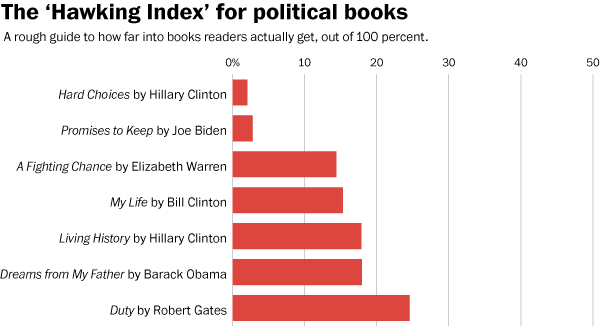
The Hawking Index of Unread Blockbusters

Hawking Index of recent Political Bestsellers

Hawking Index of recent Political Bestsellers

Until now we only had anecdotal evidence that many “blockbuster” books pushed by media and reviewers went largely unread (the most famous past example was Gravity’s Rainbow, critically acclaimed literature that was so dense and bereft of compelling narrative that few purchasers actually finished it.)

But now we have the “Hawking Index,” named after Stephen Hawking for his Brief History of Time, also hugely recommended and rarely finished. While we have no way of knowing how many Major Books purchased in hardcover at bookstores end up as doorstops, we now have data from Amazon Kindle books, which make available on their Amazon pages the location and number of notations users make within the book; it turns out many books have notations near the beginning but few or none near the end, indicating users did not make it that far. Since many books do have notations to the end, we know it’s not just because readers get tired of annotating; they simply stop reading.

WaPo has a good story on this, adding Hillary Clinton’s latest as another much-purchased, rarely-finished book, to go along with Thomas Piketty’s Capital in the Twenty-First Century as a best-selling bust with readers:

The summer’s most-read book? Donna Tartt’s “The Goldfinch.” Least-read? Thomas Piketty’s “Capital in the Twenty-First Century,” for which the notations only get about 2.4 percent of the way in.

So, naturally, we decided to apply this methodology to “Hard Choices” and other recent or comparable political books. And we have our own ranking, which we now present in order from estimated-least- to estimated-most-read.

1. “Hard Choices,” by Hillary Clinton. Hawking Index: 2.04 percent. Well, there you have it. The deepest into Hard Choices the popular highlights get is page 33, a quote about smart power. Three of the five most-popular highlights occur within the first 10 pages. We will note the same caveat that Ellenberg applies to Piketty. “Hard Choices” is fairly new, and fairly long. Still, though, one would think more people had made it past page 33.

The most popular quote? “Do all the good you can, at all the times you can, to all the people you can, as long as ever you can.” Which, like several of the top quotes from the authors listed below, isn’t actually a quote from Hillary Clinton. Instead, it’s a mantra from her family’s Methodist faith.

I took a look at my own book and the highlights readers chose seem to indicate most readers read it all the way through — the two most popular:

Most of the trouble in relationships is about bad signaling and poor responses. (6 Highlighters)

A good partner is reliable and available to help on call, whenever possible; a good partner leaves his partner alone when help is not needed, staying quietly available behind the scenes…. (5 Highlighters)

…which I actually wrote, though some of the prettiest language highlighted by users is quoted from other books (where a thought was expressed so beautifully I could not improve upon it.)

“Pills and Starships” by Lydia Millet – Pseudo Science Fiction

Pills and Starships by Lydia Millet

Pills and Starships by Lydia Millet

As a reader of science fiction from age 6 (if Tom Swift books qualify, which they do), it pains me to see politicized and depressing stories for young people, promoted by a certain negative East Coast US mindset that believes technology and the future are bad things, that freedom of thought is dangerous, and that Progress is about appointing certain right-thinking types (the nomenklatura that are literate in the arts but not in the sciences) to direct everyone down the righteous path to equality and Utopia.

I also have a background in literary fiction: I have, for example, met John Updike at a Harvard writing class where he was a special guest, and experienced the joy of rejection slips with encouraging notes from the New Yorker. The New York/East Coast literary establishment — the academics, the publishers in Manhattan, the magazines that dictated tastes and high culture like the New Yorker — are in steep decline these days, and the damnable public insists on reading much more genre fiction, finding the literary novel less accessible and entertaining. Nothing makes a high-literary sort burn with resentment more than seeing self-published trash like 50 Shades of Gray and good science fiction like the Wool series route around the tasteful gatekeepers to make $millions for their authors.

Thus there is a temptation for literary authors whose sales are flagging to try to write in genres that might sell better. Unfortunately they sometimes try science fiction (which, if it is less technological but still projects a future society that runs on different principles, is sometimes called “speculative fiction.”) Being a futurist or technologist, or both, is not something most literary authors have the background for, and their lack of interest shows when they try it — generally they pick up the most hackneyed, uncreative current memes about the future and project them, mixed with their political biases, into a future world or society that is implausible to any student of technology or history.

A fine early example of this was Margaret Atwood’s The Handmaid’s Tale, which could only have been written by someone ignorant of the true American character. Somehow a people who are cantankerous and barely able to tolerate gun regulation are going to acquiesce to a fundamentalist religious dictatorship that enslaves women — really? Only an academic author would believe something so preposterous. The Wikipedia entry on the novel sets the scene:

Beginning with a staged terrorist attack (blamed on Islamic extremist terrorists) that kills the President and most of Congress, a movement calling itself the “Sons of Jacob” launches a revolution and suspends the United States Constitution under the pretext of restoring order. They are quickly able to take away all of women’s rights, largely attributed to financial records being stored electronically and labelled by gender. The new regime moves quickly to consolidate its power and reorganize society along a new militarized, hierarchical, compulsorily Christian regime of Old Testament-inspired social and religious ultra-conservatism among its newly created social classes. In this society, almost all women are forbidden to read.

This book became a bestseller and a movie, and the East Coast literati (with their paranoia about the feared Other, the fundamentalist religionists who were then getting headlines) were completely willing to believe that only one or two elections separated the US from a totalitarian religious state.

I was listening to NPR yesterday and heard an interview with author Lydia Millet about her new book, Pills and Starships. The book sounded like similar literati scare-mongering by someone of little or no scientific background, so I investigated further.

The PR blitzes legacy publishers can provide for a new book are still amazing. Not only is she getting a PR plug by those influence-peddlers at NPR for her crappy book, there are reviews in the Washington Post and the New York Journal of Books, as well as dozens of planted reviews at Goodreads. The book has climbed to around #2,000 on Amazon’s bestselling list but has only two reviews there so far, meaning the publisher was not able to game Amazon’s review system as effectively.

The world she proposes for the future (from the Amazon page):

Earth reached its ecological tipping point some years ago, and corporations now manage all aspects of life. No more babies are being born, the elderly must purchase contracts to die, and drugs (“pharma”) control a dwindling human population. Natalie’s parents have purchased a death contract, and they have one final week together. The 17-year-old must keep a journal, which she addresses to an unknown space traveler—the only place where starships come into the story. As the Bountiful Passing approaches, Nat and her rebellious younger brother, Sam, begin to make plans to save their parents, or, at the very least, to rescue themselves from the tyranny of the corps and their Death Math. A predictable plot and strained teen voice distract from the very beginning and with 90-plus pages of backstory, the real action doesn’t begin until well into the book. The ecological theme, clearly a passion of the author, unfortunately comes across as too heavy-handed and didactic in tone. An additional purchase only.—Katherine Koenig, The Ellis School, PA

Here’s her author bio from Amazon:

Lydia Millet is a novelist and short-story writer known for her dark humor, idiosyncratic characters and language, and strong interest in the relationship between humans and other animals. Born in Boston, she grew up in Toronto and now lives outside Tucson, Arizona with her two children, where she writes and works in wildlife conservation. Sometimes called a “novelist of ideas,” Millet won the PEN-USA award for fiction for her early novel My Happy Life (2002); in 2010, her story collection Love in Infant Monkeys was a finalist for the Pulitzer Prize. In 2008, 2011, and 2012 she published three novels in a critically acclaimed series about extinction and personal loss: How the Dead Dream, Ghost Lights, and Magnificence. June 2014 will see the publication of her first book for young-adult readers, Pills and Starships — an apocalyptic tale of death contracts and climate change set in the ruins of Hawaii.

She has no background in economics, history, or hard sciences, but with “feelings” and a literary sensibility, she is willing to project a stunningly unimaginative future designed to reinforce current public school emphasis on “climate change” and the depressing fate that awaits us all if we don’t follow “feelings” as a guide to policy. The widespread promotion of this kind of propaganda to young people might have been useful when the education establishment drenched them in optimistic technocratic futures, but now it is just piling on a Conventional Wisdom that discourages any kind of planning for a brighter future. A subversive work now would be technologically optimistic and recognize how much better the future will be than the past for most people.

There’s a place for dystopias in Young Adult fiction, for example the Hunger Games series. But they should be sharp and imaginative and realistic about how real people respond to conditions.

Here are some fragments from reviews less influenced by PR quid pro quos:

I didn’t love this book. The book is told as a journal, with the audience some unknown spacefarer on a ship somewhere out in the solar system. And for me, that’s where it doesn’t work. Okay, I understand the point of a journal, but I think Millet sticks a little too strictly to the format, telling us far more than she shows us. If anything, the beginning drags as she explains and explains the world where Nat and Sam live.

I did care about the characters, but it would have been more enjoyable for me to see things as they unfolded. Millet even describes the dialog in places, rather than recounting it — or trying to recount it — which comes across as a rookie mistake. Just when the plot was getting good, the book ended, too, which left me feeling like I’d missed something. — Dean Fetzer at LitReactor.com

… When, from beneath the glossy surface, a disturbing reality begins to emerge, Nat’s emotionally flat narration makes it hard to care. Passive and without affect, she accepts her parents’ choices and later abandons her brother during a horrendous storm with elegiac regret. Despite exposition that’s rarely interrupted by dialogue, this world’s puzzlingly out of focus, real places carelessly portrayed. The novel’s narrative conceit has Nat explaining her story to a hypothetical distant reader. Summarizing the action robs it of suspense and interest: Readers do not see the story unfold and watch characters act and interact, making it difficult for them to interpret their behavior for themselves.

Detail may be the lifeblood of fiction, but storytelling is its pumping heart; without it, this all-premise effort is DOA. — Kirkus Reviews

In other words, it’s bad fiction as well as bad science fiction. Yet it will be sold and pumped up by the ideologically-biased publishing industry, which is doing a fine job of destroying itself by promoting the dull and correct while blocking the novel and subversive works of much better authors.

For an update on this topic and the ongoing war in gaming see: YA Dystopias vs Heinlein et al: Social Justice Warriors Strike Again

For more on pop culture:

The Lessons of Walter White
“Blue Valentine”
“Mad Men”
The Morality of Glamour
“Mockingjay” Propaganda Posters
“Big Bang Theory” — Aspergers and Emotional/Social Intelligence
Real-Life “Hunger Games”: Soft Oppression Destroys the Poor
Reading “50 Shades of Grey” Gives You Anorexia and an Abusive Partner!
YA Dystopias vs Heinlein et al: Social Justice Warriors Strike Again
“Raising Arizona” — Dream of a Family

Amazon vs. Hachette: Future of Publishing

amazonhachette
You may have heard of the ongoing contract struggle between Amazon and Hachette, one of the big four publishers left after a decade of consolidation in the industry. Amazon has been a big factor in disrupting the business of getting books to readers, after the previous decade saw big-box booksellers undercutting and eliminating a lot of independent bookstores. While I know many people are nostalgic for the small bookstore experience — browsing, serendipitous discovery, personal recommendations — the digitization of books was bound to make that a niche experience. Like most people over thirty, I grew up reading books from the library and the few bookstores in my area; this limited what I could read to what had passed a series of gatekeepers, so while the selection was good in quality it was also homogenized to reach larger audiences and limited in amount.

With ebooks you will see a variety of changes as the written word is freed from some of the strictures of conventional publishing. For example, the economies of scale of paperback marketing, printing and shipping meant there was little profit to be made from short books, so the standard size of a paperback novel rose from 200-300 pages to 400-600 pages, as publishers pressured authors to write longer to increase profit margins. With ebooks, there is much less friction for smaller works, so novels will tend to be less padded and epics less dominant. Amazon has even introduced Kindle Singles, novellas or even short stories and short nonfiction at their natural length and priced appropriately. The legacy publishing industry had abandoned these forms, with only magazines left to print them and in increasingly limited quantities and lower payments for authors. So many established authors are unearthing earlier work considered “uncommercial” and releasing it in this form, which benefits everyone.

Legacy publishers provided valuable services in filtering, editing, and marketing author’s work, but in recent years had focused on bestsellers as the economics of publishing what is called “midlist” (steady but small sellers, of less mass-market interest) discouraged them. This was in part due to big box book retailing; when Costco and Target sell more printed books than all but the largest chain, discounted commodity books win, all others lose.

In reaction, publishers are learning to work with successful self-published authors who created their own markets and fan bases. The two most famous examples are the 50 Shades of Grey series and the Wool novels, both cultivated by the authors through online marketing to sales high enough to prove their value to mass-market publishers. Signing with legacy publishers gave these authors more distribution and marketing muscle to reach the half of the population that still only sees books in stores.

Publishers, editors, marketers, and agents are also unbundling services to allow very small and self-publishers access to a la carte services as needed. There’s now a thriving online market in proofreading, editing, layout, cover design, marketing, PR, and negotiation. The sort of homogenized, focus-group-driven blockbusters legacy publishers had focused on will continue to be produced, but there is now a path for long-tail books (which speak to tiny audiences and must therefore have lower costs) to be produced in large numbers. Authors who are read will make as much money as they did from the publishers, and have a freer hand to execute their visions. Of course this also means there will be a lot of hopeful but dreadful authors self-publishing, so the old gatekeeping function of publishing will have to come from independent reviews and word-of-mouth from readers, which means it will take much longer for a new book to become known.

This post was motivated by a post on the Smashwords blog. Smashwords is an ebook distribution platform competing with Amazon, so their view of Amazon as predatory is partly self-interested, but it is a nice discussion of the issues. It is certainly possible Amazon increased author royalties on ebooks to get authors away from publishers, then may squeeze royalities later as their market power increases, but the existence of many alternative platforms like Smashwords should keep that in check. Amazon’s advantages in search and user reviews is very large, though, and it’s clear that if they wanted to they could squeeze authors — but so far they have not.

Press Kit: The Long Bio

Press_Kit

Putting together a press kit (which saves time when contacting bookstores and the like.) Converted the short bio used in the book to first person and added some of the colorful details:

I was born and raised in Kansas City, Missouri, child of a schizophrenic father and a hardworking single mother. In high school, I was written up by the local newspaper for my perfect record on math tests. When I was selected for a student question panel for a book tour lecture by Jonas Salk, I asked Dr. Salk why he had written a book of strained analogies and unsupported assertions (Man Unfolding.) I won a variety of awards, including the ACS award for best chemistry student in the city.

I studied astronomy and computer and cognitive science at MIT. My advisor was earth scientist Frank Press, Jimmy Carter’s science advisor at the time. TA’d and wrote exams for Planetary Physics and Chemistry. Studied with Hal Abelson (co-inventor of Logo and Scheme) and wrote a Scheme (Lisp) interpreter for 8080 machines, a notable feat because of memory size limitations. Short-term jobs at the Harvard-Smithsonian Center for Short-Lived Phenomena and Electromagnetic Launch Research under Henry Kolm, who was revealed much later to have been the intelligence officer who ran Project Paperclip to secretly bring Nazi rocket scientists to the US.

At Bolt, Beranek, and Newman (BBN) Labs, member of the team developing a multiprocessor testbed for AI applications as part of the Strategic Computing Initiative under DARPA. Ray Tomlinson, who chose ‘@’ as the email separator when designing the first internetwork email system, worked down the hall. Wrote Multilisp manual, found multiprocessor garbage collection bugs that no previous machine had seen. Moved to Symbolics and started work on their parallel processor, but but funding setbacks ended that project. After a short stint in grad school, moved to Vancouver, BC, Canada to start a software company.

In Vancouver, started a land development project on a nearby island and subdivided despite fierce political opposition. Gained experience in logging, road-building, and water and sewer systems. On the island’s Water and Waste Subcommittee for the new Community Plan. Stayed five years and became a landed immigrant, but decided to return to the US.

Software work included programs modeling the behavior of simulated stock traders using genetic algorithms and participation in the design work for Apple’s Dylan, a new object-oriented language (scrapped before release.)

Moved to the San Francisco Bay Area to start a family office for a Stanford professor (an old MIT friend) whose company had gone public, making him suddenly wealthy. Managed a large portfolio and timed sales of company stock to diversify. Woke up one morning to see the World Trade Center in flames and the market closed; advised client not to sell when the market reopened. Retired some years later when I faced the choice of starting a much larger hedge fund or starting a new career (again.)

Happily married and retired to Palm Springs now, I write to explain how things really work.

More on Avoidant and Bad Boyfriends:


Game of Thrones and the Problem of Power

game-of-thrones-season-4

[HT to friend Frank Yellin for pointing this out.]

Rolling Stone has a long interview with George R. R. Martin, writer of the Game of Thrones series. I saw him signing books at the World Science Fiction Convention some years back, and he was already a star before HBO turned his series into a mass market hit.

One of the reasons why the series (a riff on the kind of clashes seen between family dynasties in the Middle Ages, set in a kind of fantasy Europe) is popular is its realistic portrayal of both responsible and irresponsible lusts for power, unintended consequences, and the difficulties of governing even for those of noble intentions. Everyone acts out of what they think are their interests, and in keeping with their character, and yet the results are often completely unexpected and tragic.

As Martin comments:

Q: A major concern in A Song of Ice and Fire and Game of Thrones is power. Almost everybody – except maybe Daenerys, across the waters with her dragons – wields power badly.

A: Ruling is hard. This was maybe my answer to Tolkien, whom, as much as I admire him, I do quibble with. Lord of the Rings had a very medieval philosophy: that if the king was a good man, the land would prosper. We look at real history and it’s not that simple. Tolkien can say that Aragorn became king and reigned for a hundred years, and he was wise and good. But Tolkien doesn’t ask the question: What was Aragorn’s tax policy? Did he maintain a standing army? What did he do in times of flood and famine? And what about all these orcs? By the end of the war, Sauron is gone but all of the orcs aren’t gone – they’re in the mountains. Did Aragorn pursue a policy of systematic genocide and kill them? Even the little baby orcs, in their little orc cradles?

In real life, real-life kings had real-life problems to deal with. Just being a good guy was not the answer. You had to make hard, hard decisions. Sometimes what seemed to be a good decision turned around and bit you in the ass; it was the law of unintended consequences. I’ve tried to get at some of these in my books. My people who are trying to rule don’t have an easy time of it. Just having good intentions doesn’t make you a wise king.

For more on pop culture:

The Lessons of Walter White
“Blue Valentine”
“Mad Men”
The Morality of Glamour
“Mockingjay” Propaganda Posters
“Big Bang Theory” — Aspergers and Emotional/Social Intelligence
Real-Life “Hunger Games”: Soft Oppression Destroys the Poor
Reading “50 Shades of Grey” Gives You Anorexia and an Abusive Partner!
YA Dystopias vs Heinlein et al: Social Justice Warriors Strike Again
“Raising Arizona” — Dream of a Family

For more on politics and unintended consequences:

Life Is Unfair! The Militant Red Pill Movement
Madmen, Red Pill, and Social Justice Wars
Unrealistic Expectations: Liberal Arts Woman and Amazon Men
Stable is Boring? “Psychology Today” Article on Bad Boyfriends
Mate-Seeking: The Science of Finding Your Best Partner
The “Fairy Tale” Myth: Both False and Destructive
Why We Are Attracted to Bad Partners (Who Resemble a Parent)
Culture Wars: Peace Through Limited Government
Social Justice Warriors, Jihadists, and Neo-Nazis: Constructed Identities Disregarding Facts

The Morality of Glamour

Karl May

I recently read and reviewed Virginia Postrel’s excellent The Power of Glamour, in which she touches on the issues of positive and negative uses of glamour in persuasion — advertising, propaganda, entertainment and branding. She is primarily interested in defining glamour and determining how it is produced by the careful editing of reality to cast a spell on susceptible audiences that has the power to motivate actions — from purchases, to career choices, and even emigration and warfare.

I recently wrote my own book, Bad Boyfriends, which addresses an analogous phenomenon — limerence, or being “in love,” a powerful neurochemical-emotional state that also casts a spell over the observer.

Of course the typical glamours of fashion photography, Hollywood star photographs, or cinema adventures are today so common that most observers are largely immune to their effects — while caught in the spell and enjoying temporary immersion in it, they know it is neither real nor readily attainable. But the effect of both glamour and limerence depends on the susceptibility of the observer, and the construction of a dream of the future self by either glamorous presentations or a few sightings and encounters with the object of limerence can become obsessive for the observer who is starving for that dream.

And as with glamour, age and experience reduce limerence’s power. While a young person might give up his home and job to pursue either a dream career or the fantasy mate, the older and wiser have seen this play before, and know how to enjoy the fantasy and pursue it a little while not irrationally sacrificing the advantages of their current life.

Postrel writes, “Glamour fuels dissatisfaction with the here and now, even as it makes present difficulties easier to endure by suggesting the existence of better alternatives…. By tendering the promise of escape and transformation, glamour feeds on both hope and hardship.” So one’s already drab, boring life looks even worse by comparison, if you are say a German young man around 1900 reading the then-popular Western pulp novels (like those of Karl May); but then you start to obsess over your plan to escape to the Klondike to strike it rich in the new gold rush, and you have goal to work toward and a plan that fills your heart with joy in anticipation. The writer Karl May had never visited the West or met a cowboy, but he still spun an illusion strong enough to motivate thousands.

Similarly, limerence has launched its victims toward both achievement and destruction, sometimes both. Postrel cites Helen of Troy as one of the earliest documented cases of glamour, and it could be said that her power was to induce limerence in nearly everyone who observed her, leading to her kidnapping, war, and the destruction of Troy.

So we come to the question that every sensitive person whose job is to persuade via glamour in advertising or marketing considers: is what I am doing moral? When I create a glamour, I am setting a trap for the susceptible members of my audience that will create inside their heads a persuasive and persistent model of a future they dream of being part of. As always in persuasion, to feel that it is moral one must have a sense that on the whole you are doing those who are persuaded a favor; that they will be better off having purchased that new BMW or party dress, or taking up a career in the Navy.

Critics of persuasion by glamour can cite many examples where slick advertising and presentations caused victims to do harm to themselves — as mild as buying something they did not need and did not use, in which case they traded some money for a brief sense of pleasure in the having of the object. Or as serious as the spell cast over many of the German people by the Nazis using filmed propaganda, with revived pseudoclassical symbols and theories of Aryan mysticism, to justify their expansion and the demonization of “subhumans.”

Similarly, Sigmund Freud’s nephew, Edward Bernays, the “father of PR,” (and father of my Harvard fiction writing teacher!), began the use of mass market persuasion techniques that included what today would be called “viral marketing,” by creating images and narratives designed to be picked up by the mass media and so persuade millions through a combination of advertising and free publicity. His “Torches of Freedom” campaign, which in hindsight seems evil, used a staged demonstration of actresses pretending to be freedom-fighting women demanding the freedom to smoke cigarettes. The National Post comments:

On Easter Sunday, 1929, about a dozen female socialites marched along Manhattan’s Fifth Avenue, ostentatiously smoking cigarettes. Their mission: to fight the stigma against public smoking for women. According to The New York Times, the women insisted that they weren’t holding mere cigarettes but “torches of freedom.”

The march was choreographed by Vienna-born PR pioneer Edward Bernays, then on retainer with the American Tobacco Company. The story is vintage Bernays: a quintessential example of his knack for manipulating public opinion with evocative images and phrases. Bernays had learned from his uncle, Sigmund Freud, that people were basically irrational, driven by instincts. The enterprising nephew unabashedly exploited this insight, appealing to emotions and not intellect whether he was selling Ivory Soap or Calvin Coolidge. The approach revolutionized consumer culture.

Bernays influenced political communication, too. He was dismayed to learn that his 1923 book, Crystallizing Public Opinion, was in Nazi propagandist Joseph Goebbels’ bookcase. Still, in another context, Bernays would likely have approved of Goebbels’ claim, that “in the long run basic results in influencing public opinion will be achieved only by the man who is able to reduce problems to the simplest terms and who has the courage to keep forever repeating them in this simplified form, despite the objections of the intellectuals.” Both men knew well: The public opinion battlefield is the heart, not the head.

believe_woman_smoking

If we are thinking morally, this is usually where we get off the persuasion bus. Let’s suppose that we believe what we want to persuade the public to do will be good for them, on the whole; but we are going to elide the details that might “complicate” their evaluation of our proposals, leaving out the real-life problems that may come up, and make simplified assertions that anyone who understands the situation well will know cannot possibly be the whole truth.

And, voilà! Obamacare!

By a series of steps it is possible to convince an otherwise well-meaning and honest person (or entire political party) that lying over and over again to persuade people to give you permission to spend a trillion dollars on a complex program (too complex, it turns out, to actually be executed well or as planned) that benefits a few people a lot, somewhat more people a little, and harms the balance, sometimes significantly. A billion dollars was spent on duplicative software, mostly wasted; hundreds of millions more on advertising which also left out any significant problems the plan might create for some; and hundreds of millions of dollars more on foot soldiers to promote and assist (and remind the beneficiaries who gave them the gift.) The President was an unusually glamourous figure and supported by both Hollywood and the glamour of rhetoric and dream-spinning. But alas, behind the glamour there was a lack of competence in execution, despite good intentions.

Destruction comes to those who believe the glamour they have spun around themselves. To make this a nonpartisan roasting, note the Bush administration in Iraq, who very successfully used the US’ competent and overwhelming military to bring down Saddam Hussein in only a few days with the least loss of life and property of any major war in history. Hubris was achieved shortly thereafter, when the occupation dismantled existing police and government functions to (they thought) create a brand new government and society based on US models of representative government and modern freedoms. The resulting chaos and civil war more than wiped out any advantage gained for either the US or the Iraqi people. Good intentions did not magically create good results.

The greater the risk being taken with the audience’s lives or fortunes, the less justifiable is any misleading persuasive technique, including glamour. We should always be asking, “What if I am wrong? What is the downside of what I want them to do if they are not successful? How painful and destructive is disillusionment from the illusion I am trying to create?”

This article from MarketingProfs discusses the new world of marketing where there are so many sources of information and eager writers among the public that creation of lying spin is much harder (despite the example of Obamacare, which was enabled by a certain uniformity of background — and lack of economic knowledge — of most media reporters.) To quote:

Today, people who want to make great stories can use technology to influence public perception, rather than shape public perception around a lie. Think of it like this: Consumers no longer buy out of a fear of not having something; they buy because the product has the potential to enhance their personal story. Progressive marketing companies such as SHIFT Communications and TGPR talk more about how we make and share real stories—rather than “tell” them.

Dreams of being beautiful and admired (fashion, cosmetics, jewelry…) or powerful, wealthy, and admired (luxury cars, watches, ski houses in Aspen…), competent and skilled and admired (Olympic athletes, dancers, musicians…) are all worthy. One question to ask when you are spinning up a glamour aimed at young people is: how many of them can actually achieve it? Say you have written a script about a ghetto kid who takes up basketball and makes it to the big leagues, suffers one crisis when he takes his new position and love interest for granted, and (heartwarmingly) learns to wisely value those who care for him. What happens to the kids who focus on basketball and neglect other things? While we know most will be disappointed, we also know any kind of focus on achievement is better than no focus. What are the offramps along the way for those who fail to get the brass ring? Going to a good school on a scholarship gives the kid a chance to pick up other skills and find other dreams. Being on a team and showing up regularly for practice teaches the most important skills of holding any job.

It’s clear that people need their dreams, and glamour can lead them in directions they did not expect or know of, but were ready for. The mass marketing of glamour has accelerated the dissatisfaction with what is, and the motivation to create the “what ifs” we call progress. The increasing availability of information uncontrolled by one or a few sources means the future is being created by a glamour with more realism, tucked just out of sight but known to be there. But it can still excite the mind and make the heart beat faster, and move the dreamer to take the chance on the dream.

For more on pop culture:

The Lessons of Walter White
“Blue Valentine”
“Mad Men”
“Mockingjay” Propaganda Posters
“Big Bang Theory” — Aspergers and Emotional/Social Intelligence
Real-Life “Hunger Games”: Soft Oppression Destroys the Poor
Reading “50 Shades of Grey” Gives You Anorexia and an Abusive Partner!
YA Dystopias vs Heinlein et al: Social Justice Warriors Strike Again
“Raising Arizona” — Dream of a Family

The Power of Glamour

Power of Glamour

Power of Glamour

The Power of Glamour, by Virginia Postrel.

One of the duties of our public intellectuals is to mine the culture for fresh new ways of seeing and describing the world, bringing together seemingly disparate examples and finding regularities and order in what had only been vaguely understood before. Virginia Postrel has been at this for years, and her latest work is a wonderful read that will help anyone in design, advertising, photography, publicity, or any of the arts of persuasion understand at a deeper level how this dream-making works.

When I was living in Vancouver, I had a friend — Clark Candy, a cousin of John Candy’s — who had recently moved from Toronto after a career in advertising. A motorcycle accident had crushed his knee, and during the long rehab process he decided not to go back to work in advertising, which he felt had little meaning — persuading people to buy things they did not need by trickery and slick lies, eliding ugly realities. He later went on to help produce glamorous TV productions like Once Upon a Time, so he ended up doing much the same work as he did before; perhaps if he had read this book then he might have seen more meaning in his advertising work. Mad Men‘s Don Draper is a character who creates glamours for a living, and is himself a crafted image hiding a troubled soul; but without glamour and aspiration, life would be drained of the spur to progress and self-actualization of these imagined futures.

Glamour, she writes, exists between the viewer and the viewed. It is a subjective illusion of an effortless life, a higher and better self that you might become if only you could put yourself into the picture. A glamour is a spell, like a reverie or dream of your future created by images and ideas. She points out that glamour has always existed — Homer’s epics recited in ancient Greece produced yearnings for lives of heroism and unforced grace in listeners not dissimilar to today’s comic book heroes; artists were commissioned to create paintings of idealized existences to reinforce and inspire the real models, as well as present their favored image to others.

But the enormous increase in mass-produced imagery in the last century has given glamour a new importance, as more and more high-powered images are present in even the poorest people’s lives. Like any tool of persuasion, glamour can be used for good (inspiring young people to work toward careers they might otherwise have never achieved) or ill (politicians use glamour in propaganda — Nazis, Italian fascists, and the USSR, for example.)

With a wealth of examples, the reader is able to make generalizations and follow along as she lays out a new vocabulary for discussing glamour: Sprezzatura, the effortless grace of achievement, a stylish performance without apparent sweat or concern (which of course conceals endless practice and polishing;) theatrical grace, the kind of glamour produced by the artifice of hiding the effort to produce it behind the stage scenery; darkroom grace, created by editing and eliding the flaws and selection of what to leave out (as of a photo) to produce an image with the emotional power to fuel a dream unencumbered by the details of its production.

She casts her net wide in the cultural landscape and brings in examples from every part of high and low culture: Hollywood, comic book heroes, cowboys, Gibson Girls, Star Trek, Princess Di, Che Guevara, Helen of Troy and Achilles, theater, industrial design, Mad Men, and Apple. The examples and photographs are delightful and consistently entertaining.

The hardcover itself is an example: perfectly laid out, a sensual pleasure to read and feel. I rarely read anything but ebooks these days, but for this work about a primarily visual phenomenon, the hardcover is the wise choice. It’s the ideal coffee table book.